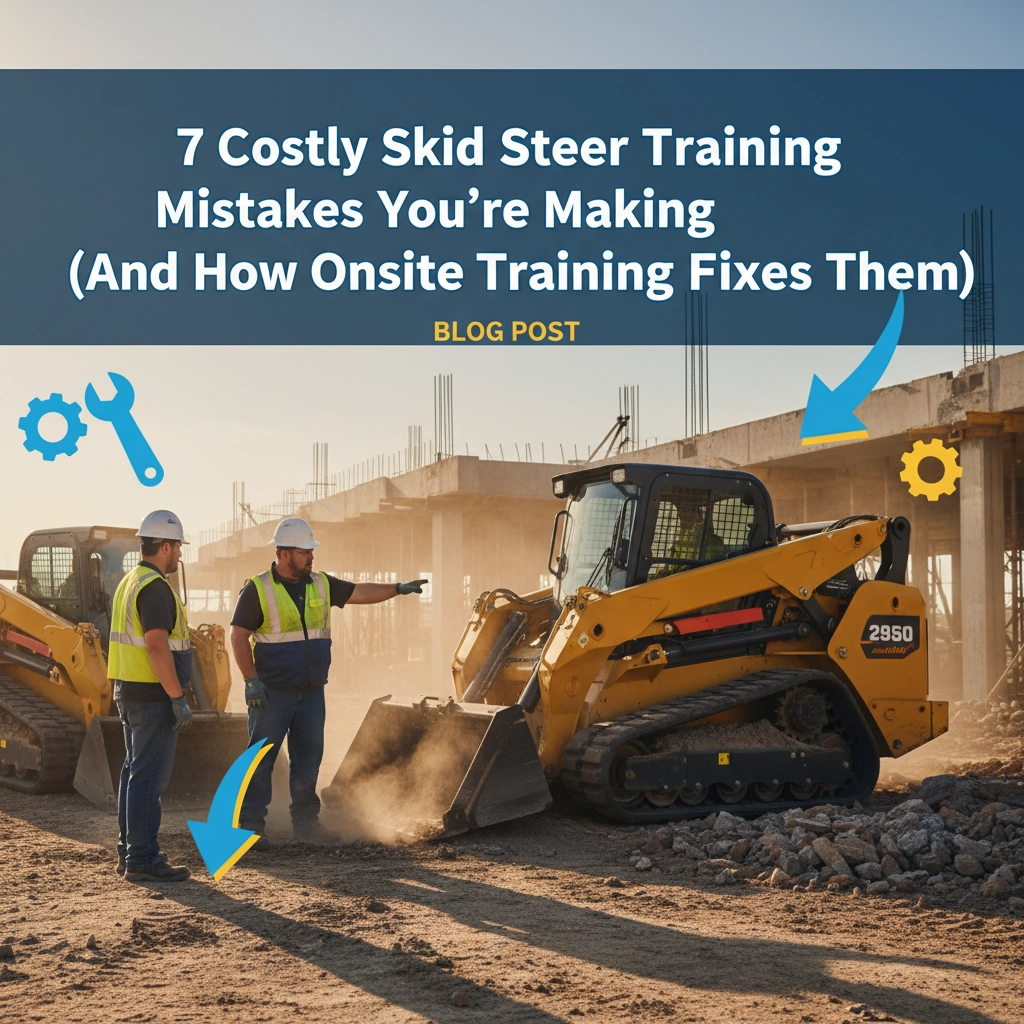
7 Costly Skid Steer Training Mistakes You’re Making (And How Onsite Training Fixes Them)
Seven costly skid steer training mistakes, from carrying the bucket too high to skipping inspections, and how onsite training fixes them in Manitoba.
Last updated on October 1, 2026
What's new in this update:
- Added Manitoba's 2026 regulatory timeline, including M.R. 26/2026 and its April 1, 2027 in-force date
- Added the current CSA B335:25 reference for operator instruction, evaluation, and trainer refresh expectations
- Added a recent Manitoba enforcement example showing the cost of missing instruction and safe work procedures
- Expanded Manitoba fall and winter operating risks, including freeze-thaw conditions, ice, snow, cold hydraulics, and reduced daylight
- Verified the closing contact link is active
When you're managing training programs for your community members, every dollar counts. You're not just investing in skills development: you're building pathways to sustainable employment and safer workplaces. But here's the reality: skid steer training done wrong costs more than money. It costs jobs, equipment, and sometimes lives.
After working with employment and training departments across Manitoba, we've seen the same expensive mistakes repeated over and over. The good news? Every single one is preventable with proper onsite training. Let's dive into the seven costliest errors and how the right training approach transforms your outcomes.
Mistake #1: Operating with the Bucket Positioned Too High
This is the mistake that kills careers and budgets faster than any other. When operators carry the bucket high while traveling: especially on slopes or uneven ground: they're creating a tipping hazard that can destroy a $75,000 machine in seconds.
The Real Cost: Beyond equipment damage, workplace accidents drive up insurance premiums and can result in WorkSafe Manitoba claims that follow your trainees to future job sites. One rollover incident can blacklist an operator from construction sites across the province.
How Onsite Training Fixes It: Our trainers don't just tell operators to keep the bucket low: they demonstrate why. Using your actual work environment, we show how quickly center of gravity shifts and create muscle memory through repetitive practice. When your community members enter the workforce, they carry this safety-first mindset that makes them valuable employees.

Mistake #2: Ignoring Load Capacity and Manufacturer Guidelines
You've invested in getting your people certified, but if they don't understand equipment limits, they're walking liability magnets. Overloading attachments doesn't just break machines: it creates safety hazards that can shut down entire job sites.
The Real Cost: Equipment repairs average $15,000-25,000 per incident. But the hidden cost is reputation. Construction companies remember which training programs produce operators who damage equipment. Your graduates get passed over for jobs because their training source has a reputation problem.
How Onsite Training Fixes It: We make manufacturer specifications part of the daily routine. Every training session includes hands-on practice with load calculations and attachment limits. Your trainees learn to read equipment manuals like safety documents: because that's exactly what they are. When they enter the workforce, they're known as operators who protect equipment and maximize uptime.
Mistake #3: Improper Attachment Mounting and Securing
Loose attachments cause accidents, but they also signal unprofessional training. When an operator can't properly secure a bucket or fails to position it correctly before exiting the cab, it screams amateur hour to site supervisors.
The Real Cost: Beyond the obvious safety risks, improperly mounted attachments reduce productivity by 20-30%. Your graduates take longer to complete tasks, making them less competitive in the job market. Site supervisors notice operators who waste time struggling with basic procedures.
How Onsite Training Fixes It: Every training session includes attachment mounting practice until it becomes automatic. We teach the proper sequence: secure the attachment, test the connection, position for exit. This isn't just about safety: it's about building operators who work efficiently and professionally from day one.
Mistake #4: Skipping Pre-Operation Inspections
Here's what happens when operators skip pre-op checks: small problems become expensive failures. Hydraulic leaks that could be caught early destroy entire systems. Loose bolts that take minutes to tighten cause hours of downtime.
The Real Cost: Preventable breakdowns cost Canadian construction companies an average of $3,200 per incident in downtime alone. When your graduates cause these failures, they don't get called back. Word travels fast in Manitoba's construction community.
How Onsite Training Fixes It: We build inspection habits that stick. Every training day starts with a complete walk-around inspection. We explain what to look for and why it matters. Your graduates enter the workforce known for preventing problems, not causing them. Site supervisors value operators who keep projects on schedule.

Mistake #5: Poor Turning Technique and Site Damage
Hard turns and aggressive maneuvering don't just damage work sites: they announce inexperienced operators. Professional operators plan their movements and execute smooth, controlled turns that minimize ground damage.
The Real Cost: Site damage charges can range from hundreds to thousands of dollars per incident. More importantly, operators who tear up work sites get labeled as costly and unreliable. Your training program's reputation suffers when graduates cause preventable damage.
How Onsite Training Fixes It: We teach movement planning and smooth operation techniques. Your trainees learn to think three moves ahead and execute turns in designated areas. They understand speed selection and how to maintain control in tight spaces. These skills make them valuable team members who protect project budgets.
Mistake #6: Failing to Adapt to Environmental Conditions
Manitoba weather creates challenging operating conditions. Operators who don't adjust their technique for wet, frozen, or unstable ground create safety hazards and equipment damage.
In fall and winter, the risks increase quickly. Freeze-thaw cycles can change ground stability from one part of a site to another. Ice requires a hazard assessment and clear exclusion zones. Snow clearing near people, parked vehicles, and active traffic routes raises the risk of struck-by incidents. Cold weather can also slow hydraulic response, which changes how the machine reacts. Shorter daylight hours add another layer of risk when visibility drops early in the day.
The Real Cost: Weather-related accidents spike insurance costs and create WorkSafe Manitoba incidents. Equipment damage from poor environmental decisions averages $8,000-12,000 per claim. Your graduates need skills that work in real Manitoba conditions.
How Onsite Training Fixes It: We train in your local environment and weather conditions. Your community members learn to assess ground stability, adjust for seasonal conditions, set safe work zones, and maintain control on challenging terrain. They enter the workforce prepared for Manitoba's reality, not textbook scenarios.

Mistake #7: Inadequate or Inconsistent Training Standards
The biggest mistake isn't technical: it's accepting substandard training. When training lacks hands-on practice, real-world scenarios, and consistent standards, your community members enter the workforce unprepared.
Training standards are also changing. Manitoba Regulation 26/2026 was registered on March 20, 2026 and comes into force on April 1, 2027. It removes the construction site safety exemption for commercial, industrial or institutional construction and renovation sites with more than 25 workers on site at any one time, or buildings over 600 m2, or more than three storeys. It also adds prime contractor duties under section 4.7. Communities planning community operator training for larger projects should prepare now so operators, supervisors, and project leaders are ready before the new requirements apply.
There is also an updated benchmark for equipment instruction. CSA B335:25, released in May 2025, replaced CSA B335-15 and is the recognized baseline for lift truck operator training. It recognizes online learning and virtual reality simulation for instruction and evaluation, while expecting trainers to retrain every three years. But the hands-on practical evaluation is still the part that proves competency. That matters for skid steer training too: classroom learning helps, but practical skill on the machine is what shows an operator can work safely.
The Real Cost: Inadequately trained operators face higher accident rates, lower employment retention, and limited career advancement. Your training investment fails to deliver sustainable employment outcomes for your community.
How Onsite Training Fixes It: Professional onsite training creates consistent, industry-recognized competency. Your trainees receive the same high-standard instruction that major construction companies provide their own operators. This levels the playing field and opens doors to better employment opportunities.
The ROI of Getting It Right
Documentation also matters as much as instruction. Training records, evaluations, safe work procedures, and site-specific hazard controls help show that standards were actually taught and applied. A recent Manitoba enforcement case shows the cost of getting this wrong. On March 27, 2026, Manitoba Natural Resources and Indigenous Futures was convicted after a 2022 fatal ATV rollover. The case involved three Workplace Safety and Health Regulation contraventions and a $100,000 fine. The lesson is simple: missing operator instruction and safe work procedures carry the highest cost.
Let's talk numbers that matter to your training budget. Proper skid steer training costs approximately $500-800 per person. Poor training costs thousands per incident in equipment damage, accident claims, and lost employment opportunities.
Consider this: one properly trained operator who works safely for five years generates approximately $200,000 in wages. That's $200,000 staying in your community, supporting families, and building economic stability. Multiply that by each person you train, and the community impact becomes significant.
When your graduates are known for safety, professionalism, and competency, construction companies actively recruit from your program. You're not just training individuals: you're building your community's reputation as a source of skilled, reliable operators.
Making the Investment Work
For employment and training departments in Manitoba's First Nations communities, onsite training delivers measurable returns:
Immediate Benefits:
- Higher certification pass rates
- Reduced training time through focused, practical instruction
- Lower insurance costs due to improved safety records
Long-term Outcomes:
- Increased employment placement rates
- Higher starting wages for graduates
- Stronger relationships with construction companies
- Community economic development through skilled workforce
The choice is straightforward: invest in professional onsite training that produces job-ready operators, or continue losing money on inadequate programs that fail your community members.
Your training program can be the pathway to sustainable employment and economic growth. But only if you commit to doing it right. The seven mistakes we've outlined aren't inevitable: they're completely preventable with proper training standards.
Ready to transform your skid steer training outcomes? Contact us to discuss how onsite training can deliver the safety, competency, and employment results your community deserves.
More guides
Need your operators certified?
We bring the training to your site, on your own equipment. Tell us the machines and how many operators and we reply the same business day.