Forklift Safety Compliance in Manitoba: Lessons from Real Workplace Fines
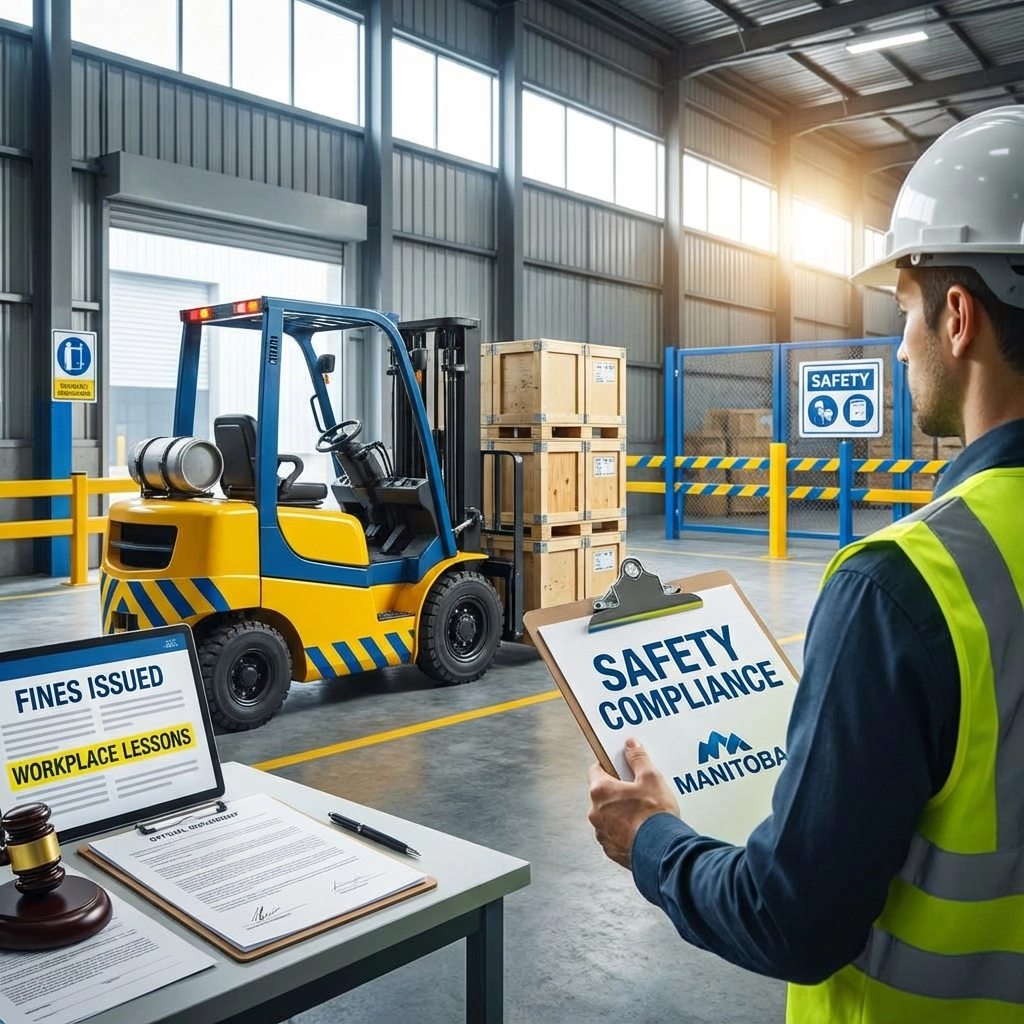
Real Manitoba forklift fines show what inspectors look for: training records, CSA B335:25 instruction, practical evaluation and daily inspection logs.
Last updated on October 1, 2026
What’s new in this update
- Updated the washroom compliance section to reflect that Manitoba’s menstrual product requirement is now in force as of September 1, 2026, including free tampons and pads, covered disposal containers near each toilet, and penalties that can reach $5,000
- Corrected the M.R. 26/2026 timeline and scope: the regulation was registered March 20, 2026 and comes into force April 1, 2027, so employers should use 2026 to prepare for the end of the exemption on larger commercial, industrial, and institutional construction and renovation sites, along with new prime contractor duties under section 4.7
- Replaced the outdated CSA B335-15 reference with CSA B335:25 and added the employer impacts that matter most, including recognized online and virtual reality delivery methods, stronger risk assessment expectations, and the three-year retraining expectation for trainers
- Added the March 27, 2026 conviction of Manitoba Natural Resources and Indigenous Futures to show that Manitoba is prosecuting public sector employers too when safe work procedures and operator instruction are missing
Just after morning break at a Winnipeg stone shop on March 15, 2023, a granite slab dropped while being moved with a forklift. A worker was hurt. Ital-Stone Design Ltd. later pleaded guilty to failing to provide a safe workplace and was fined $20,000, plus a $5,000 payment to Manitoba’s public education fund. See the CBC report: Two Winnipeg companies fined $20K each after employees injured.
For Manitoba employers, forklift certification Manitoba is not just a paperwork issue. It is part of a broader workplace safety duty that now includes stronger expectations around employer responsibility, current washroom compliance requirements, and planning for regulatory changes that take effect in 2027.
Stories like this aren't rare, and they're not random. They usually trace back to the same gaps: incomplete training, missing procedures, and thin documentation. Then comes the investigation, fines, downtime, and lost productivity. For Manitoba employers, the price of non-compliance is always higher than investing in proper forklift training, competency evaluation, and recordkeeping.
The High Cost of Forklift Non-Compliance
When Manitoba's workplace safety inspectors investigate forklift incidents, they're looking for specific compliance failures that consistently appear in violation notices and penalty assessments. Understanding these common infractions helps employers recognize where their operations are most vulnerable to regulatory action.
The most expensive violations typically involve inadequate operator training, insufficient safety documentation, and failure to maintain proper equipment inspection records. These aren't technical oversights: they're fundamental compliance requirements that form the backbone of Manitoba's forklift safety regulations.
Recent prosecutions also show that enforcement is not limited to private industry. On March 27, 2026, Manitoba Natural Resources and Indigenous Futures was convicted after a 2022 fatal ATV rollover and fined $100,000 for three contraventions of the Workplace Safety and Health Regulation. The case is a reminder that the province is prosecuting public sector employers too, and that missing safe work procedures and operator instruction are often the common thread when incidents turn into convictions.

Critical Training Requirements That Prevent Fines
Manitoba's forklift safety framework, built on the CSA B335:25 national standard, establishes mandatory training requirements that employers must document and maintain. This standard replaced the 2015 edition in May 2025 and is now the recognized baseline for lift truck operator training. Violations in this area consistently generate the most significant penalties because proper training directly prevents the incidents that trigger investigations.
CSA B335:25 matters to employers because it recognizes online and virtual reality simulation as acceptable delivery methods for instruction and evaluation under Clause 6.1.2, strengthens risk assessment expectations, and sets a three-year retraining expectation for trainers under Clause 7.2 unless local rules say otherwise. That strengthens a basic compliance point many employers still miss: forklift training should be delivered by qualified trainers, not by an in-house operator who has experience but no trainer certification.
The 2026 M.R. 26/2026 amendments have also reinforced that some sites once seen as "small" will soon face stricter safety expectations. The regulation was registered March 20, 2026 and comes into force April 1, 2027. When it does, it removes the exemption for commercial, industrial, or institutional construction and renovation sites where more than 25 workers are or are expected on site at any one time, or where the building will be more than 600 m² or more than three storeys. It also adds prime contractor duties under section 4.7. Employers should treat this as a readiness issue for 2026 and early 2027, making sure training, supervision, and documentation are fully in place before the change takes effect.
These updates also reflect a wider employer duty. Workplace safety is not limited to machine guarding and lift operation. Employers are expected to take a broader view of safety that includes stronger internal responsibility systems and practical measures that support worker well-being. That now includes Manitoba's menstrual product access requirement, which is already in force as of September 1, 2026. Every provincially regulated Manitoba workplace must provide free tampons and pads plus a covered disposal container near each toilet, in workplace washrooms or in an accessible private location where that is not reasonably practicable. Non-compliance can bring fines up to $5,000.
Theoretical Training Components
Every forklift operator must receive comprehensive theoretical instruction covering:
- Basic physics of forklift operation and stability principles
- Load capacity calculations and center of gravity concepts
- Pre-operational inspection procedures and documentation requirements
- Traffic patterns, signaling protocols, and pedestrian safety measures
- Emergency procedures and incident reporting protocols
- Manitoba-specific regulatory requirements and employer policies
Practical Skills Evaluation
Beyond classroom instruction, operators must demonstrate competency through hands-on evaluation in actual workplace conditions. This practical assessment must cover:
- Load handling techniques with various types of materials
- Navigation in tight spaces and around obstacles
- Proper use of attachments and specialized equipment features
- Emergency response procedures under realistic conditions
- Integration with warehouse or facility-specific safety protocols
The documentation of this training becomes critical evidence during compliance inspections. Employers without proper records face immediate penalties, regardless of their operators' actual skill levels.
Common Violations Leading to Manitoba Penalties
Enforcement patterns reveal specific areas where employers repeatedly fail compliance requirements, resulting in consistent penalty assessments. Understanding these failure points helps employers prioritize their compliance efforts where they'll have the greatest impact.
Inadequate Documentation Systems
Many penalties stem from documentation failures rather than actual safety deficiencies. Inspectors require comprehensive records including:
- Initial operator training certificates with specific completion dates
- Regular refresher training schedules and completion documentation
- Daily pre-shift inspection logs with operator signatures
- Equipment maintenance records and safety system checks
- Incident reports and corrective action documentation
Operator Certification Gaps
Employers frequently face penalties for allowing uncertified operators to use equipment, even temporarily. This includes:
- New employees operating forklifts before completing required training
- Experienced operators working without current certification renewals
- Supervisors or managers operating equipment without proper credentials
- Temporary workers or contractors lacking verified training records
Equipment Safety Violations
Physical equipment violations generate immediate stop-work orders and substantial penalties:
- Damaged or missing safety equipment like backup alarms and lights
- Improperly functioning hydraulic systems or steering mechanisms
- Missing or illegible load capacity plates and operating instructions
- Inadequate maintenance creating unsafe operating conditions

Equipment-Specific Compliance Challenges
Different types of powered industrial trucks present unique compliance requirements that employers must address through specialized training and documentation protocols.
Standard Counterbalance Forklifts
These workhorses of industrial operations require specific attention to load center calculations and stability principles. Operators must understand how load weight and positioning affect the truck's center of gravity, particularly when handling unusual or oversized materials.
Training documentation must demonstrate competency in recognizing capacity limitations and implementing proper load handling procedures that prevent tip-overs and load drops: the incidents most likely to trigger serious penalties.
Reach Trucks and Order Pickers
These specialized trucks operate in narrow aisles and elevated positions, creating unique safety challenges that require additional training components. Operators need specific instruction in:
- Aisle navigation and clearance calculations
- Elevated work platform safety when applicable
- Battery handling and charging procedures for electric units
- Integration with warehouse management systems and traffic control
Rough Terrain Forklifts
Outdoor applications present environmental hazards that indoor operators may not encounter. Compliance requirements include training on:
- Ground condition assessment and stability considerations
- Weather-related operational limitations and safety procedures
- Enhanced visibility requirements for outdoor operations
- Coordination with other mobile equipment and vehicle traffic
Building Your Compliance Foundation
Creating a robust compliance program requires systematic implementation of training, documentation, and ongoing maintenance protocols that will withstand regulatory scrutiny and prevent costly violations.
Establish Comprehensive Training Protocols
Start with forklift certification training that exceeds minimum requirements. This investment in thorough initial training prevents the remedial costs and penalties associated with compliance failures.
For many employers, that also means connecting forklift certification Manitoba with a broader heavy equipment operator training plan. A consistent training standard across forklifts, aerial lifts, skid steers, and other mobile equipment helps reduce gaps that often lead to incidents, fines, and downtime.
Your training program should include equipment-specific modules for each type of powered industrial truck in your facility, ensuring operators understand the unique safety requirements and operating procedures for their assigned equipment.
Implement Documentation Systems
Create systematic record-keeping that captures all required compliance elements:
- Digital training records with automatic renewal reminders
- Daily inspection logs integrated with maintenance scheduling
- Incident tracking with root cause analysis and corrective actions
- Regular compliance audits with documented improvement plans
Schedule Regular Refresher Training
Manitoba regulations require ongoing competency verification, not just initial certification. Establish regular refresher training schedules that address:
- New safety procedures and regulatory updates
- Equipment modifications or facility changes
- Incident lessons learned and improvement opportunities
- Skills assessment and remedial training where needed

Practical Solutions for Immediate Compliance
Employers facing compliance gaps need actionable steps they can implement immediately to reduce their exposure to penalties and improve their overall safety posture.
Conduct Immediate Training Audits
Review all operator certifications and identify gaps in current training records. Document any operators working without proper credentials and schedule immediate training to address deficiencies.
Verify that training content meets current CSA B335:25 standards and includes Manitoba-specific requirements that inspectors expect to find in compliance documentation.
Upgrade Equipment Inspection Procedures
Implement daily pre-shift inspection requirements with documented checklists that operators complete before beginning work. These records provide critical evidence of due diligence during compliance investigations.
Establish maintenance schedules that address safety-critical systems before they create compliance violations, including hydraulic systems, warning devices, and operator protection features.
Create Emergency Response Protocols
Develop clear incident response procedures that minimize regulatory exposure while ensuring proper worker protection. This includes:
- Immediate scene safety and worker care protocols
- Proper notification procedures for serious incidents
- Evidence preservation and documentation requirements
- Coordination with regulatory authorities and insurance providers
Professional Training Solutions
Working with experienced safety training professionals eliminates guesswork and ensures your compliance program meets current regulatory standards while providing practical value for your operations.
Onsite Training Services specializes in comprehensive forklift operator training that goes beyond minimum compliance requirements to create genuinely competent operators who contribute to safer, more efficient operations.
If your operation uses multiple types of mobile equipment, our operator training programs help employers align forklift certification Manitoba requirements with practical heavy equipment operator training across the workplace.
Don't wait for a compliance violation to expose gaps in your safety program. Request a quote to schedule a comprehensive training assessment that identifies your specific compliance needs and develops practical solutions that protect your workers and your business.
The cost of proper training is always less than the cost of penalties, incidents, and the operational disruption that follows compliance failures. Make the investment in professional training that keeps your operations running safely and legally.
Contact Onsite Equipment Training to book your certification program.
More guides
Need your operators certified?
We bring the training to your site, on your own equipment. Tell us the machines and how many operators and we reply the same business day.