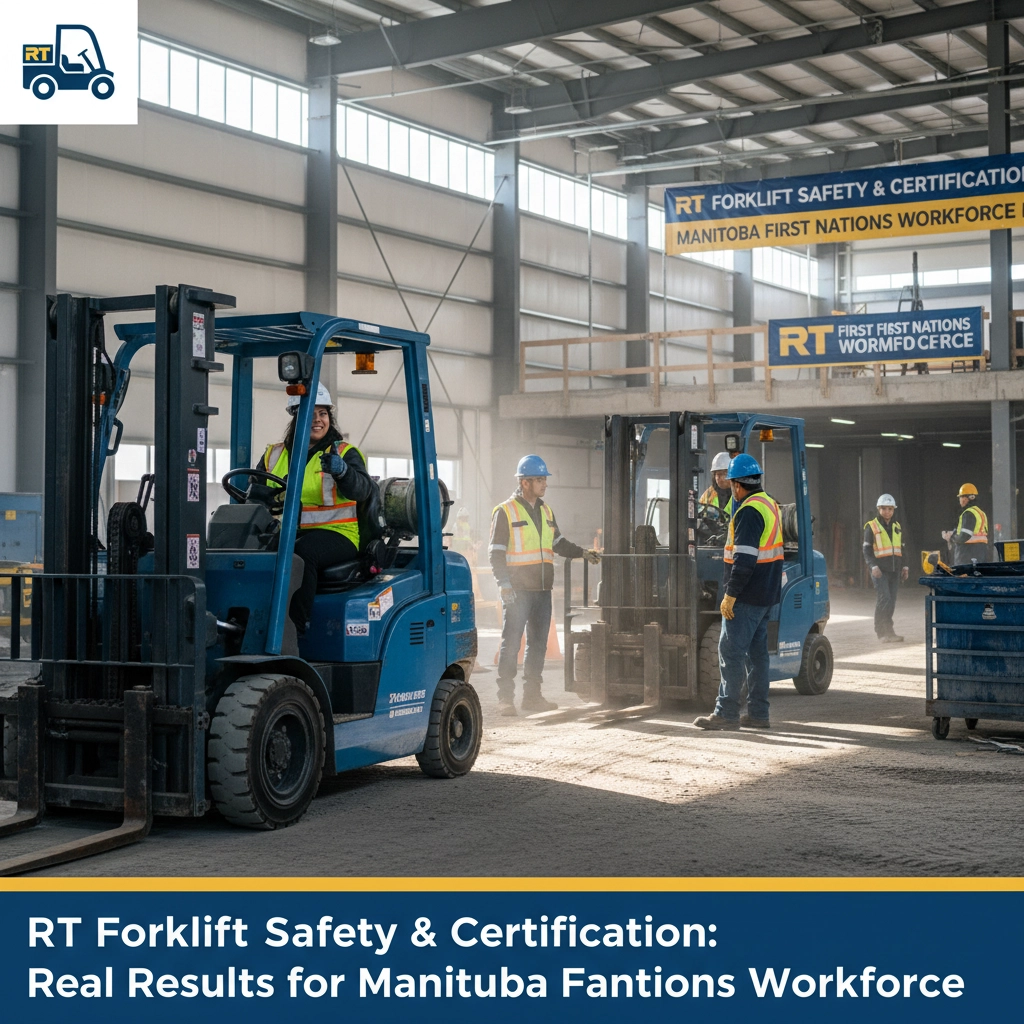
RT Forklift Safety & Certification: Real Results for Manitoba First Nations Workforce
How Manitoba First Nations use RT forklift certification to create jobs: community case studies, on-site delivery, wage gains and CSA B335:25 training.
Last updated on October 1, 2026
What's new in this update:
- Updated the lift truck training reference from CSA B335-15 to CSA B335:25.
- Added Manitoba's 2026 regulatory update affecting larger construction and renovation projects.
- Added a 2026 enforcement example showing how operator instruction, safe work procedures, and documentation are enforced.
- Added September 2026 mining and critical minerals context relevant to First Nations workforce planning.
When you're responsible for workforce development in a First Nations community, every training dollar needs to deliver measurable results. You can't afford programs that look good on paper but fail to create lasting employment opportunities for your people.
That's exactly why Manitoba First Nations employment and training departments are increasingly turning to Rough Terrain (RT) forklift certification as a strategic workforce investment. The results speak for themselves: higher employment rates, better wages, and stronger community economic development.
Why RT Forklift Training Matters for First Nations Workforce Development
Rough terrain forklifts aren't your typical warehouse equipment. These machines handle the heavy lifting in construction, mining, forestry, and industrial projects: sectors where First Nations workers have significant opportunities but often lack the specific certifications employers demand.
Unlike standard forklifts that operate on smooth warehouse floors, RT forklifts navigate uneven terrain, outdoor conditions, and challenging work environments. This makes them essential for the resource-based industries that form the backbone of Manitoba's economy, particularly in northern and rural communities where many First Nations are located.

The certification process now aligns with CSA B335:25, released in May 2025, which replaced the 2015 edition and is now the recognized baseline for lift truck operator training. For community programs, that matters because the updated standard recognizes online learning and virtual reality simulation as valid delivery and evaluation methods, sets stronger expectations around risk assessment, and expects trainers to retrain every three years. Certification validity remains three years. Workers still need to learn how to handle variable ground conditions, weather challenges, and the increased stability requirements that come with outdoor industrial operations.
Case Study: Norway House Cree Nation's Construction Workforce Initiative
Norway House Cree Nation partnered with Onsite Training Services in 2024 to certify 24 community members in RT forklift operations as part of their construction workforce development program. The initiative targeted unemployed and underemployed community members aged 19-45.
The Challenge: Local construction projects required certified RT forklift operators, but community members lacked the specific certification. Without certified operators, these positions were filled by workers from outside the community, reducing local economic benefits.
The Solution: A comprehensive 3-day RT forklift certification program delivered directly in the community, combining classroom theory with hands-on practical training on actual rough terrain equipment.
The Results:
- 22 of 24 participants achieved certification (92% success rate)
- 18 participants secured employment within 90 days (75% placement rate)
- Average wage increase of $4.50/hour compared to previous employment
- Combined first-year earnings increase of $168,000 for certified workers
- 3 participants advanced to equipment operator supervisor roles within 12 months
Breaking Down Employment Barriers Through Targeted Certification
Many First Nations workers possess strong mechanical aptitude and work ethic but face employment barriers due to missing specific certifications. RT forklift training addresses this gap strategically.

Immediate Employability: Unlike multi-year apprenticeship programs, RT forklift certification provides immediate workforce entry credentials. Graduates can seek employment immediately upon certification completion.
Industry Recognition: The certification meets employer requirements across multiple sectors including construction, mining, forestry, and transportation. This broad applicability maximizes employment opportunities for certified workers.
Wage Premium: RT forklift operators typically earn $2-6 more per hour than general laborers, creating meaningful income improvements for families and communities.
Fisher River Cree Nation: Economic Development Through Skills Training
Fisher River Cree Nation's economic development corporation invested in RT forklift training as part of their broader workforce preparation strategy. They certified 15 community members to support their expanding construction and maintenance operations.
Program Structure:
- 2-day intensive certification course
- Morning theory sessions covering safety regulations, equipment inspection, and operational procedures
- Afternoon practical training on community-owned RT forklift equipment
- Follow-up mentoring and job placement support
Measurable Outcomes:
- 100% certification success rate (15 of 15 participants)
- 13 participants immediately employed in community projects (87% local placement)
- 2 participants secured external employment with regional contractors
- Average hourly wage increase of $3.75 for certified operators
- Reduced reliance on external contractors for community projects, keeping $47,000 in local wages annually
Addressing Rural and Remote Training Challenges
First Nations communities often face unique training delivery challenges: geographic isolation, limited transportation options, and the need for culturally appropriate program delivery. Our RT forklift certification program specifically addresses these barriers.
Communities also need to keep one eye on changing Manitoba rules while planning training. M.R. 26/2026 was registered on March 20, 2026 and comes into force on April 1, 2027. It removes the construction site safety exemption for commercial, industrial, or institutional construction and renovation sites with more than 25 workers on site at any one time, and a building area over 600 m2 or a height over three storeys. It also adds prime contractor duties under section 4.7. For communities involved in larger housing, public building, and infrastructure projects, this is worth planning for now because documentation, site coordination, and operator readiness will matter even more.
On-Site Delivery: Training comes directly to your community, eliminating transportation barriers and allowing participants to train while maintaining family and community responsibilities.
Flexible Scheduling: Programs accommodate community schedules, cultural events, and other priorities. Weekend and evening options available.
Cultural Competency: Instructors understand First Nations workplace cultures and communication styles, creating more effective learning environments.

Equipment Provision: We bring the training equipment, so communities don't need to invest in expensive machinery for certification purposes.
Peguis First Nation: Building Long-Term Economic Capacity
Peguis First Nation approached workforce development strategically, identifying RT forklift certification as a cornerstone skill for their economic development plans. They certified 28 community members over two training cohorts.
Year One Results:
- Cohort 1: 12 participants certified, 11 employed within 60 days
- Cohort 2: 16 participants certified, 14 employed within 90 days
- Combined wage improvements totaling $89,000 annually
- 4 certified operators started their own small contracting businesses
Long-Term Impact:
- Community now has trained operator pool for economic development projects
- Reduced project costs through local hiring
- Increased community capacity for infrastructure maintenance
- 3 certified operators pursuing additional heavy equipment certifications
The Economic Multiplier Effect
RT forklift certification creates ripple effects beyond individual wage improvements. When community members secure better-paying jobs, they spend more locally, supporting community businesses and creating additional economic activity.
Recent enforcement also shows why strong training systems matter for every employer, including public and community organizations. On March 27, 2026, Manitoba Natural Resources and Indigenous Futures was convicted after a 2022 fatal ATV rollover and fined $100,000 for three Workplace Safety and Health Regulation contraventions. The case reinforces a simple point: operator instruction, safe work procedures, and documentation are not optional. They are enforced.
Family Benefits: Higher wages mean improved housing, better nutrition, and increased educational opportunities for children.
Community Benefits: Local hiring keeps wages circulating within the community rather than flowing to outside workers.
Long-Term Development: Certified workers often pursue additional training, creating pathways to supervisory roles and equipment operator positions.
Making the Investment Case
The broader labour market also supports the investment case. September 2026 Winnipeg Free Press reporting noted that Manitoba is pushing to grow mineral production while First Nations training capacity still lags, and industry groups are developing on-reserve micro-credentials to help close that gap. In that environment, current-standard RT forklift certification gives community members a practical advantage right now. It is a recognized, job-ready credential that can help people step into construction, mining support, logistics, and industrial work while longer-term sector training capacity continues to grow.
For employment and training departments managing limited budgets, RT forklift certification delivers strong return on investment:
Cost Per Participant: Significantly lower than multi-year training programs while delivering immediate employability.
Success Rates: Consistently high certification and placement rates across participating communities.
Wage Impact: Measurable hourly wage increases that compound over workers' careers.
Community Retention: Training delivered locally helps retain workers in home communities rather than requiring relocation for employment opportunities.

Implementation Support and Ongoing Partnership
Successful workforce development requires more than just training delivery. We provide comprehensive support throughout the certification process and beyond:
Pre-Program Planning: Working with your employment team to identify participants, schedule training, and coordinate logistics.
Equipment and Materials: All necessary training equipment, materials, and certification documentation provided.
Post-Training Support: Job placement assistance, employer connections, and follow-up tracking to ensure successful employment outcomes.
Program Evaluation: Detailed reporting on participant outcomes, employment placement, and wage impacts to demonstrate program effectiveness.
Next Steps for Your Community
If you're ready to create tangible employment outcomes for your community members, RT forklift certification provides a proven pathway to better wages and economic development.
The communities highlighted above didn't achieve these results by accident. They made strategic investments in targeted skills training that directly addressed employer needs and community economic development goals.
Your employment and training department can achieve similar results. Contact Onsite Training Services to discuss how RT forklift certification can strengthen your workforce development outcomes and create lasting economic benefits for your community.
The question isn't whether your community needs more certified equipment operators: it's how quickly you can get them trained and employed.
More guides
Need your operators certified?
We bring the training to your site, on your own equipment. Tell us the machines and how many operators and we reply the same business day.