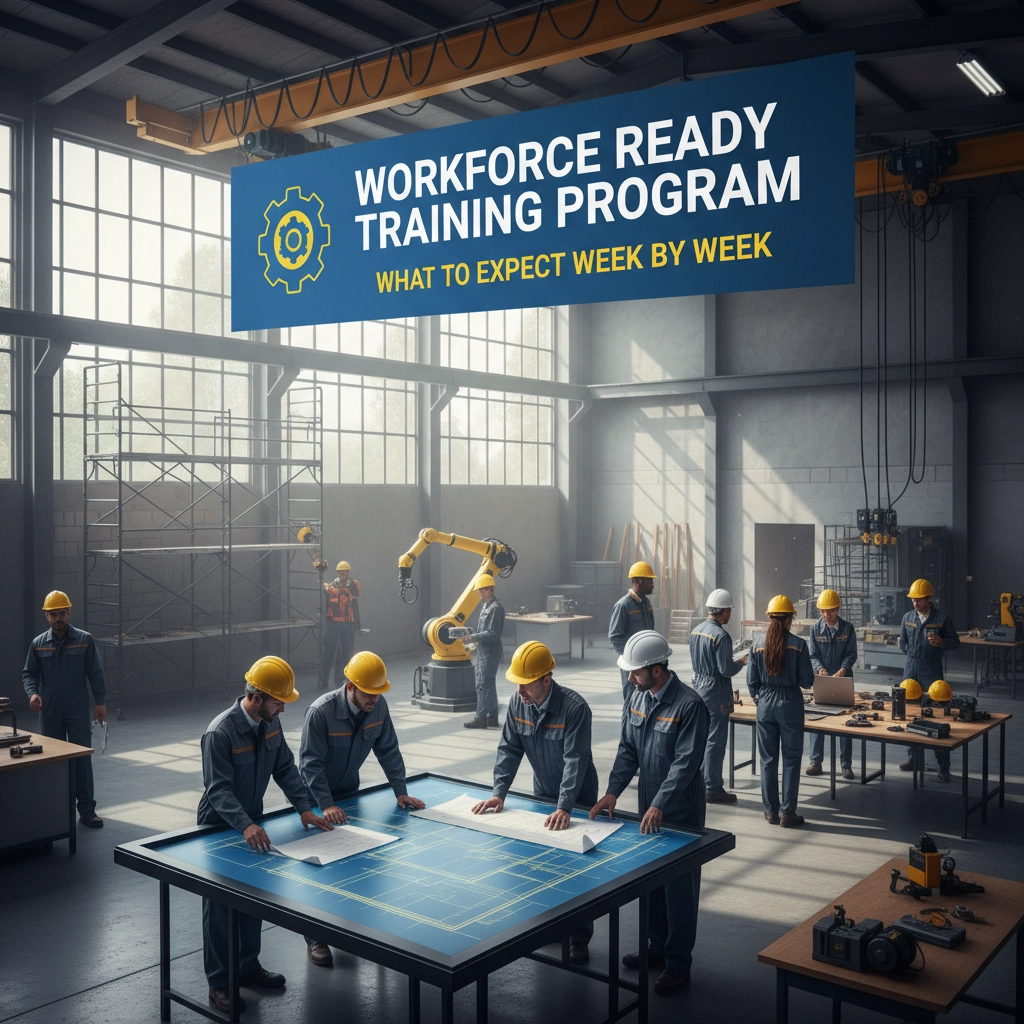
A Complete Guide to the Workforce Ready Training Program (What to Expect Week by Week)
What to expect in the Workforce Ready program: the 2-week heavy equipment track, the 1-week forklift logistics track, daily schedule and certification.
Last updated on October 1, 2026
What's new in this update:
- Updated the instructor experience wording to reflect combined team field experience
- Added current Manitoba safety and certification context under The Workplace Safety and Health Act, Manitoba Regulation 217/2006, Part 22, and CSA B335:25
- Added the 2026-2027 Manitoba regulatory timeline affecting documentation and employer due diligence
- Updated employment outcomes with current September 2026 mining, critical minerals, and water operator training context
- Refreshed the funding section to reflect current ISET, Indigenous Services Canada, and band-level support options
- Verified and corrected the program funding link
Planning to enroll in the Workforce Ready Training Program? Whether you're an employment counselor helping clients, a Band considering training options, or a job seeker ready to build marketable skills, this guide breaks down exactly what to expect from day one through certification.
The Workforce Ready program is designed specifically for individuals who need practical, job-ready skills without traditional barriers like high school diplomas or driver's licenses. Here's your complete roadmap to success.
Two Program Tracks: Choose Your Path
2-Week Heavy Equipment Program
- Skid steer operation and certification
- Telehandler training and safety protocols
- Construction site safety fundamentals
- Equipment inspection procedures
1-Week Logistics Program
- Forklift operation and certification
- Warehouse safety protocols
- Load handling techniques
- Equipment maintenance basics
Both programs are designed with the same philosophy: hands-on learning that prepares you for immediate employment. No theory-heavy coursework that doesn't translate to the job site.

Week 1: Heavy Equipment Program Foundation
Days 1-2: Safety First, Equipment Second
Your first two days establish the foundation that keeps you safe and employable. Morning sessions focus on workplace safety regulations, personal protective equipment (PPE), and understanding your legal responsibilities as an equipment operator.
You'll learn why safety training protects both you and your future employer from Criminal Code negligence charges. This isn't just about following rules, it's about building the mindset that separates professional operators from accidents waiting to happen.
Afternoons introduce you to your first piece of equipment. You'll conduct pre-operational inspections, learn basic controls, and begin developing muscle memory for essential movements. Expect to feel overwhelmed initially, this is normal and temporary.
Days 3-4: Hands-On Skill Building
By day three, you're spending more time in the operator's seat than in the classroom. Instructors draw on combined team field experience to guide you through increasingly complex maneuvers.
Skid steer training focuses on precise movements, load distribution, and site awareness. You'll practice picking up materials, navigating tight spaces, and working around obstacles, skills that directly translate to construction sites.
Telehandler training emphasizes height safety, load charts, and stability principles. You'll understand why a 2,000-pound load behaves differently at 20 feet than at ground level.
Day 5: Real-World Applications
Friday brings everything together with workplace simulations. You'll complete tasks that mirror actual job site conditions, working under time pressure while maintaining safety standards.
Instructors evaluate your technical skills, safety awareness, and decision-making abilities. This isn't about perfection, it's about demonstrating competency and good judgment.
Week 2: Advanced Skills and Certification Prep
Days 6-7: Multi-Equipment Proficiency
Week two expands your capabilities across multiple equipment types. You'll switch between skid steers and telehandlers, learning how different machines handle various tasks.
This cross-training is valuable because employers prefer operators who can handle multiple pieces of equipment. It also helps you understand which machines work best for specific applications.
Days 8-9: Workplace Integration
These days focus on real workplace scenarios: communicating with supervisors, coordinating with other trades, and maintaining productivity while following safety protocols.
You'll practice documenting equipment issues, understanding work orders, and managing your time effectively. These soft skills often determine whether new operators succeed long-term.
Day 10: Final Evaluation and Certification
Your final day includes comprehensive practical and written evaluations. You'll demonstrate equipment operation, safety knowledge, and problem-solving skills under evaluation conditions.
Successful completion results in recognized certification that employers trust. In Manitoba, employer obligations sit under The Workplace Safety and Health Act and Manitoba Regulation 217/2006, with Part 22 covering powered mobile equipment. For lift truck training, the current standard is CSA B335:25, released in May 2025. It replaced CSA B335-15 and recognizes online learning and virtual reality simulation for instruction and evaluation, while still requiring hands-on practical evaluation on actual equipment. The standard also expects trainers to retrain every three years. You'll receive wallet cards and documentation that proves your competency to potential employers.

1-Week Logistics Program Breakdown
Days 1-2: Forklift Fundamentals
The logistics program moves faster but maintains the same safety-first approach. Day one covers warehouse safety, equipment types, and load handling principles.
You'll begin operating forklifts immediately, learning steering, lifting, and positioning techniques. The compact timeline means every hour counts, instructors focus on essential skills that translate directly to employment.
Days 3-4: Advanced Operations
Mid-week training covers specialized techniques: stacking at height, working in narrow aisles, and handling different load types. You'll practice backing up with loads, navigating around pedestrians, and managing multiple tasks simultaneously.
Warehouse simulation exercises prepare you for fast-paced logistics environments where efficiency and accuracy both matter.
Day 5: Certification Testing
Your final day includes both written and practical evaluations. You'll demonstrate safe operating procedures, complete timed tasks, and show understanding of workplace protocols. For forklift and lift truck training, this practical check still has to happen on actual equipment. While CSA B335:25 now recognizes online and virtual reality simulation as part of instruction and evaluation, hands-on competency still matters at the point of certification.
Daily Schedule Structure
Morning Sessions (8:00 AM – 12:00 PM)
- Safety briefings and equipment inspections
- New skill introduction and demonstration
- Guided hands-on practice with instructor supervision
- Problem-solving and troubleshooting exercises
Afternoon Sessions (1:00 PM – 4:00 PM)
- Independent skill practice with instructor monitoring
- Real-world scenario training
- Equipment maintenance and documentation
- Progress evaluation and feedback
This schedule balances learning new concepts with practicing essential skills. The 7-hour training days are intensive but manageable, designed to accommodate adult learners balancing family and other responsibilities.

Evaluation Process: What Success Looks Like
Written Assessment Components:
- Safety regulations and workplace responsibilities
- Equipment specifications and operating limitations
- Emergency procedures and accident prevention
- Basic maintenance and inspection requirements
Practical Skill Evaluation:
- Equipment pre-operational inspection
- Safe equipment operation under various conditions
- Load handling and positioning accuracy
- Response to simulated workplace scenarios
Instructors use standardized evaluation criteria that reflect real employer expectations. You're not competing against other students: you're demonstrating competency against industry standards rooted in Manitoba workplace safety rules and current training standards.
Documentation and Certification
Successful graduates receive:
- Industry-recognized certification cards
- Training records for employment verification
- Equipment-specific endorsements
- Safety training documentation
This paperwork isn't just ceremonial: it's what employers need to demonstrate due diligence and comply with workplace safety regulations. In Manitoba, that legal context sits under The Workplace Safety and Health Act and Manitoba Regulation 217/2006, with Part 22 setting the framework for powered mobile equipment. Where lift trucks are involved, CSA B335:25 is now the current training standard.
Documentation is also becoming more important as Manitoba's regulatory timeline continues to evolve. M.R. 26/2026 was registered on March 20, 2026 and comes into force on April 1, 2027. It removes the construction site safety exemption for commercial, industrial, or institutional construction and renovation sites with more than 25 workers on site at any one time or buildings over 600 m2 or more than three storeys, and it adds prime contractor duties under section 4.7. For communities, employers, and project partners, clear records of training, evaluation, and certification help support due diligence on current and future worksites.
Employment Outcomes: What Happens Next
Graduates typically find employment within weeks of program completion. Starting wages for certified heavy equipment operators range from $18-25 per hour, while forklift operators typically earn $16-22 per hour.
The employment outlook remains strong. September 2026 reporting in the Winnipeg Free Press noted that Manitoba is pushing to grow mineral production while First Nations training capacity is still catching up. That matters for program graduates. When communities can move people into training and current certification quickly, they are entering a market that is actively looking for qualified workers.
There are also current examples of funded training leading directly to certification. As of September 2026, a new 15-month Drinking Water Internship supported through ISET and delivered with First Peoples Development Inc. is creating another pathway for Indigenous learners to build recognized skills and move into essential infrastructure work.
The training documentation you receive protects both you and your employer. Proper certification reduces insurance costs for employers and demonstrates your commitment to professional standards.
Funding and Support Options
ISET remains the main federal funding stream for many participants. In Manitoba, First Nations learners often access support through local agreement holders and organizations that administer Indigenous Skills and Employment Training funding.
Additional support may also be available through Indigenous Services Canada programs, depending on the training goal, community priorities, and current program criteria. In many cases, band-level employment and training offices can also help with tuition support, travel, wage subsidies, or related participation costs when funding is available.
Because funding rules can change, the best next step is to confirm current eligibility and documentation requirements before enrollment. Employment counselors can request current program information here to help streamline planning for their clients and communities.
Program Success Factors
What Makes Graduates Successful:
- Consistent attendance and engagement
- Safety-first mindset development
- Willingness to learn from feedback
- Understanding that skills develop over time
- Professional attitude toward training and evaluation
Employer Feedback on Program Graduates:
- Strong safety awareness and protocols
- Proper equipment operation techniques
- Professional approach to workplace responsibilities
- Reliable performance under supervision
The Workforce Ready program delivers exactly what its name promises: job-ready skills that employers value and workers can build careers on. Whether you choose the 2-week heavy equipment track or 1-week logistics program, you'll complete training with certified skills and clear employment pathways.
Ready to get started? Contact our training coordinators to discuss scheduling, funding options, and program availability for your specific needs.
More guides
Need your operators certified?
We bring the training to your site, on your own equipment. Tell us the machines and how many operators and we reply the same business day.