Class 3 Forklifts vs Class 7 Forklift Training: Which Certification Does Your Team Actually Need?
Class 3 or Class 7 forklift training? Compare electric warehouse trucks and rough terrain forklifts, what each course covers, and which your team needs.
Last updated on October 1, 2026
What's new in this update:
- Updated lift truck training references to CSA B335:25, which replaced CSA B335-15 in May 2025 and now serves as the recognized baseline for Class 3 and Class 7 operator training, evaluations, and trainer qualifications.
- Corrected Manitoba regulatory timelines for M.R. 26/2026 and M.R. 19/2026, including the April 1, 2027 construction-related changes and the September 1, 2026 menstrual product requirement now in force.
- Added a current Manitoba enforcement example from March 27, 2026 to show the real cost of missing operator instruction and safe work procedures.
For employers and safety officers, choosing between class 3 forklifts and a class 7 forklift training program is not just a purchasing or scheduling decision. It directly affects compliance, equipment safety, and operator readiness on the job. Understanding the difference between forklift class 3 equipment and an rt forklift used on rough terrain helps you assign the right training to the right work environment.
Understanding these distinctions is crucial for employers, supervisors, and safety departments. Your training investment affects regulatory compliance, productivity, and incident prevention, and the wrong training choice can lead to avoidable risk, equipment damage, and lost time.
What Makes Class 3 Forklifts and Class 7 Forklift Equipment Different?
The classification system exists for good reason: each forklift class serves distinct workplace environments and requires specific operational skills. Getting this right from the start saves your department time, money, and ensures your trainees are job-ready for the positions they're actually pursuing.
Class 3: Electric Motor Hand Trucks and Rider Trucks
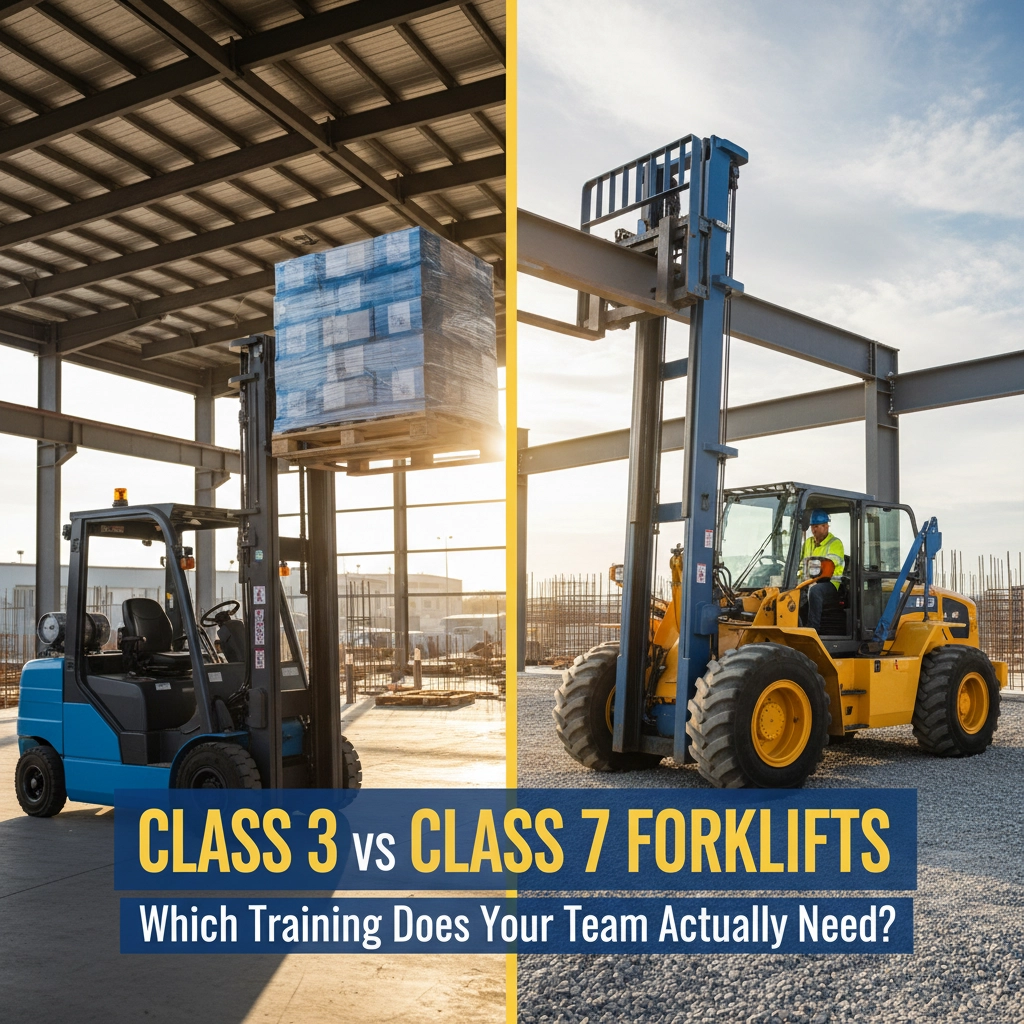
Class 3 forklifts are the workhorses of indoor material handling. These electric-powered machines dominate shipping departments, warehouses, and distribution centers across Manitoba. Think of major employers like Canadian Tire distribution centers, Walmart warehouses, or the countless shipping facilities around Winnipeg's CentrePort.

Key characteristics of Class 3 equipment:
- Electric power source (no exhaust emissions)
- Designed for level, paved surfaces
- Frequent use in tight spaces
- Lower maintenance costs
- Quieter operation for indoor environments
The electric design makes these machines ideal for enclosed spaces where air quality matters. Your trainees will work with equipment that's precision-built for efficiency in controlled environments, requiring different skills than outdoor heavy equipment.
Class 7: Rough Terrain Forklift Trucks
Class 7 forklifts are built for Manitoba's demanding outdoor work environments. These diesel-powered machines handle construction sites, mining operations, forestry work, and any situation where the ground isn't smooth concrete. From Hydro construction projects to mining sites in Thompson, these are the machines that keep resource industries running.
Key characteristics of Class 7 equipment:
- Diesel-powered engines
- Large, aggressive-tread tires for unstable terrain
- Heavy-duty construction for outdoor conditions
- Higher ground clearance
- All-weather operation capability
These machines excel where Class 3 equipment would fail: muddy construction sites, gravel yards, uneven terrain, and harsh weather conditions that are common in Manitoba's industrial sectors.
Training Requirements for Class 3 Forklifts and RT Forklift Operations
Both classes require comprehensive certification programs, but the focus areas differ significantly. Here's what employers and safety officers need to plan for:
Universal Requirements for Both Classes
Age and Basic Requirements:
- Operators must be trained and evaluated before operating workplace equipment
- No prior forklift experience is required for entry-level operator training
- A standard driver's license does not replace forklift certification requirements
- Medical restrictions should be reviewed based on job demands and employer policy
Training Structure (Required for Both Classes):
- Formal classroom instruction covering regulations, hazards, safe work practices, and equipment-specific knowledge
- Practical hands-on training with the actual equipment class
- Performance evaluation conducted by a qualified trainer or evaluator
- Refresher training when required by incidents, unsafe operation, workplace changes, or observed performance concerns
CSA B335:25 replaced CSA B335-15 in May 2025 and is now the recognized baseline for lift truck operator training. For employers using Class 3 or Class 7 trucks, training programs, operator evaluations, and trainer qualifications should all reflect this edition.
Site-specific training under Manitoba workplace requirements:
- General operator certification does not replace employer responsibility for workplace-specific instruction
- Employers must train operators on local hazards, traffic routes, load types, surfaces, and procedures
- Site orientation should reflect the actual forklift, attachments, and environment the operator will use
Class 3 Specific Training Focus
Your Class 3 program should emphasize:
Indoor Safety Protocols:
- Navigating tight warehouse spaces
- Loading dock procedures
- Pedestrian awareness in busy facilities
- Battery maintenance and charging protocols
- Inventory handling techniques
Technical Skills:
- Electric system operation and troubleshooting
- Precision maneuvering in confined spaces
- Understanding weight distribution on smooth surfaces
- Proper lifting techniques for repetitive operations
Class 7 Specific Training Focus
Your Class 7 program must include:
Outdoor Environment Assessment:
- Terrain evaluation before operation
- Weather impact on equipment performance
- Slope and grade limitations
- Mud, gravel, and uneven surface navigation
Heavy-Duty Equipment Handling:
- Diesel engine operation and maintenance basics
- Tire pressure adjustments for different terrains
- Load stability on uneven ground
- Construction site safety protocols

Employment Demand for Forklift Class 3 and RT Forklift Operators
Understanding the labour market helps employers align training decisions with actual operating needs, staffing plans, and safety requirements.
Class 3 Employment Sectors in Manitoba
Distribution and Logistics:
- Distribution centres
- Shipping and receiving operations
- Food distribution companies
- E-commerce fulfillment facilities
Manufacturing:
- Aerospace manufacturing in Winnipeg
- Food processing facilities
- Pharmaceutical companies
- Automotive parts manufacturing
Average wage range in 2026: $19-26 per hour for experienced operators
Class 7 Employment Sectors in Manitoba
Construction and Infrastructure:
- Road construction companies
- Commercial building construction sites
- Bridge and infrastructure projects
- Industrial yard operations
Resource and Industrial Sectors:
- Mining operations
- Forestry and lumber operations
- Agricultural material handling
- Energy and heavy industrial support work
Average wage range in 2026: $24-34 per hour for experienced operators
Employer demand in 2026 remains strong for qualified rt forklift operators who can work safely in outdoor conditions and handle uneven ground, changing weather, and material movement on active industrial sites.
Compliance Requirements for Class 3 Forklifts and Class 7 Forklift Use
For employers and safety officers, compliance is not just about paperwork. It is about making sure operators are trained, evaluated, documented, and prepared for the exact equipment and environment they will face on site.
Critical Compliance Points
Certification Specificity: Each operator must be trained and evaluated on the class of equipment they will use. If your operation uses both forklift class 3 equipment indoors and a class 7 forklift outdoors, training should match both applications.
Documentation Requirements: Maintain detailed training records for each operator. Documentation should show formal instruction, practical training, evaluation results, and the equipment type covered.
Site-Specific Training: Operator certification is only the starting point. Manitoba employers still need to provide site-specific training based on workplace hazards, operating surfaces, pedestrian traffic, load handling practices, and company procedures.
Current Standards Reference: Class 3 and Class 7 programs should be aligned with CSA B335:25. That includes operator instruction, practical evaluation, and the qualifications of the trainer or evaluator delivering the program.
Manitoba Regulatory Timing: M.R. 26/2026 was registered on March 20, 2026 and comes into force on April 1, 2027. It removes the construction site safety exemption for commercial, industrial, or institutional sites with more than 25 workers on site at any one time or buildings over 600 m2 or more than three storeys, and it adds prime contractor duties under section 4.7. This matters most for class 7 forklift work in outdoor construction and industrial environments where site coordination, supervision, and safe traffic control are critical.
Workplace Requirement Already in Force: If your article or internal materials still refer to the menstrual product requirement as upcoming, that language should be corrected. Under M.R. 19/2026, the requirement took effect on September 1, 2026 for provincially regulated workplaces.
Operational Planning
Before scheduling training, review where each truck will be used, what loads it will carry, and what hazards are present. Many employers benefit from separating training by task, environment, and equipment type so operators are qualified for the work they actually perform.
A recent Manitoba enforcement case also shows why training quality matters. On March 27, 2026, Manitoba Natural Resources and Indigenous Futures was convicted in relation to a 2022 fatal ATV rollover, with three Workplace Safety and Health contraventions and a $100,000 fine. For employers, the lesson is clear: missing operator instruction and safe work procedures can carry the highest cost.
Making the Right Choice for Your Operation
The decision between Class 3 and Class 7 training should align with your equipment, jobsite conditions, and compliance obligations.
Choose Class 3 training if:
- Your operators work mainly in warehouses or shipping areas
- You use electric trucks on smooth indoor surfaces
- Precision movement in tight aisles is a major part of the job
- Pedestrian traffic and dock safety are key concerns
Choose Class 7 training if:
- Your operators work outdoors on gravel, mud, or uneven terrain
- You use rough terrain units on construction or industrial sites
- Load stability on changing surfaces is a major concern
- Weather and ground conditions affect daily operations
Consider offering both if:
- Your business has both indoor and outdoor material handling needs
- Operators may move between warehouse and yard duties
- Different departments use different forklift classes
- You want broader operator flexibility without compromising compliance

Getting Started with Professional Training
Quality forklift training requires the right equipment, qualified instructors, and a practical curriculum built around real workplace hazards. Employers can see the difference between basic theory and training that truly prepares operators for safe, productive work.
When evaluating training providers, make sure they offer hands-on instruction for the actual equipment class your operators will use. Classroom learning matters, but practical evaluation is what confirms operator competence.
For employers serious about forklift certification, professional training services can provide the expertise and equipment needed for thorough operator development.
Whether you need training for class 3 forklifts, a class 7 forklift, or both, the right program helps reduce risk, support compliance, and improve operator performance. Contact Onsite Equipment Training to book your certification program.
More guides
Need your operators certified?
We bring the training to your site, on your own equipment. Tell us the machines and how many operators and we reply the same business day.