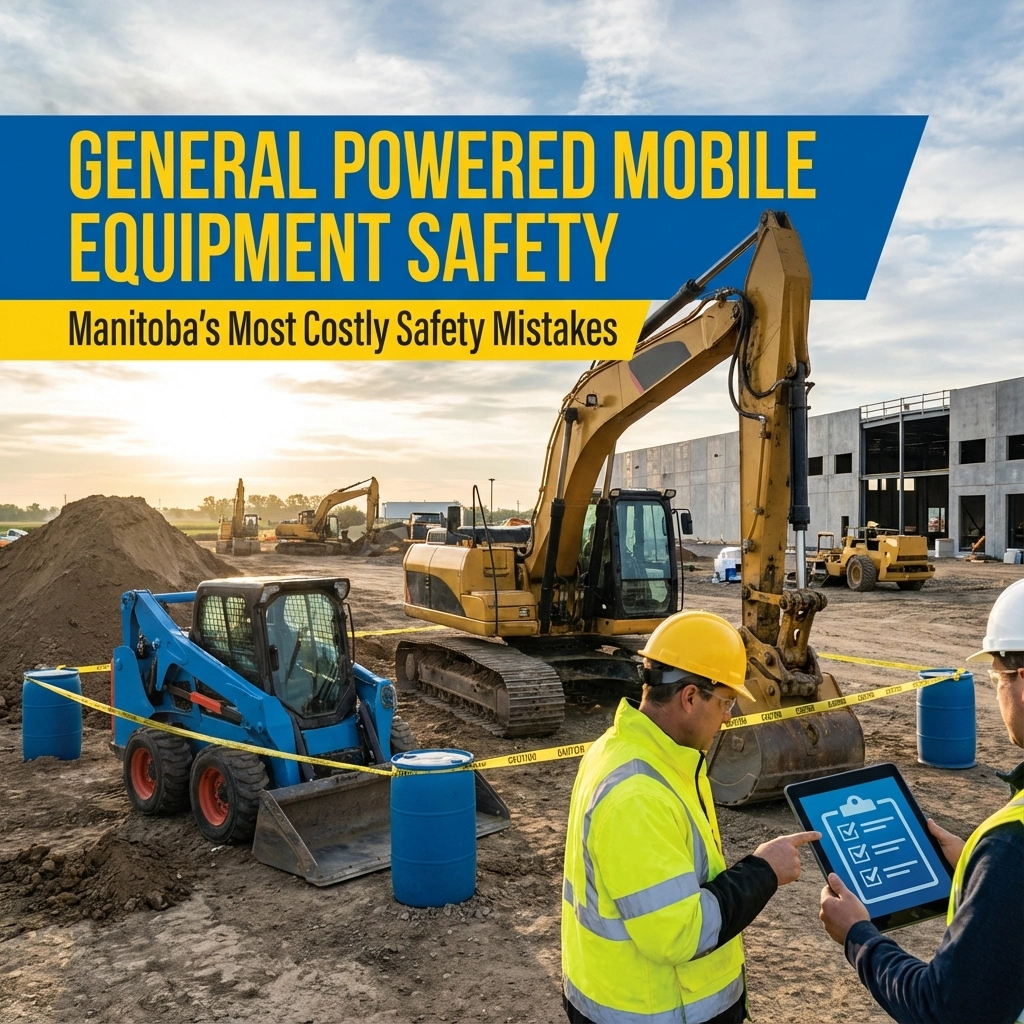
General Powered Mobile Equipment Safety: Manitoba safety compliance and Manitoba’s Most Costly Safety Mistakes
Manitoba's most costly equipment safety mistakes, from untrained operators to missing inspections, and how employers avoid fines and stop-work orders.
Here's a true-to-life example based on common inspection findings in Manitoba: On a busy loading dock last winter, a seasoned forklift operator filled in "just for a minute" in a congested aisle while a temp spotter covered another task. A pallet stacked above the truck's backrest shifted during a tight reverse, clipped a rack upright, and sent product cascading into a pedestrian path. No one was hit, but the near-miss triggered an immediate stop-work, a sweep of operator qualifications and inspection records, and days of downtime the site couldn't afford.
That scenario could have ended far worse—and it isn't rare. In Manitoba, violations involving forklifts, skid steers, telehandlers, and other powered mobile equipment routinely lead to costly stop-work orders, administrative penalties, and Workers' Compensation impacts. The good news is that most of these costs are preventable with the right operator training and a clean, inspection-ready paper trail. Strong Manitoba safety compliance practices help employers reduce risk, avoid downtime, and protect revenue before an incident turns into a major loss.
Last updated on October 1, 2026
What’s new in this update (2025–2026):
- Updated the menstrual product access section to reflect that the requirement is now in force as of September 1, 2026 under M.R. 19/2026, including free tampons and pads, covered disposal containers near each toilet, accessible private-location options where needed, and fines of up to $5,000 for non-compliance.
- Corrected the M.R. 26/2026 timeline: the amendment was registered March 20, 2026 and comes into force April 1, 2027, so employers should prepare now for expanded construction site safety duties before that date.
- Added the March 27, 2026 Manitoba Natural Resources and Indigenous Futures prosecution tied to a fatal 2022 ATV rollover, including three contraventions and a $100,000 fine, as a major 2026 enforcement example involving powered mobile equipment and safe work procedure failures.
- Retained the February 2026 Wintec Building Services Inc. prosecution as a warning about the high cost of equipment-related safety failures, including a $50,000 fine plus $20,000 directed to safety education for inadequate machine safeguarding.
- Retained the November 2025 Ital-Stone Design Ltd. conviction related to a granite slab injury during forklift transport (total penalty: $25,000).
- Kept the January 1, 2026 MTI reporting reminder for regulated-vehicle accidents and the January 2026 asbestos penalty note as signs of broad enforcement across sectors.
- Rechecked Manitoba compliance resources and kept the active provincial compliance link in place.
Understanding what drives these expensive mistakes—and how to prevent them—isn't just about compliance. It's about Manitoba safety compliance, protecting your workers, keeping production moving, and safeguarding your bottom line.
The Hidden Costs of Equipment Safety Violations (Manitoba safety compliance)

Manitoba's workplace safety enforcement has intensified significantly in recent years, with penalties reaching unprecedented levels. When powered mobile equipment violations occur, the financial impact extends far beyond the initial fines—and Manitoba safety compliance expectations are being enforced consistently across industries.
Direct costs include:
- Work stoppage orders that halt operations immediately
- Administrative penalties ranging from hundreds to tens of thousands of dollars
- Legal fees and court costs for serious violations
- Increased Workers' Compensation Board premiums
- Equipment downtime during investigations and corrections
Indirect costs often exceed direct penalties:
- Lost productivity during work stoppages
- Emergency replacement of unqualified operators
- Rush training costs to get operations back online
- Damage to company reputation and client relationships
- Difficulty securing future contracts due to safety record
Most Expensive Violation: Operating Without Proper Training (operator training)
The single most costly mistake Manitoba employers make involves allowing workers to operate powered mobile equipment without adequate operator training and certification. This violation typically triggers immediate work stoppage orders and can result in charges under the Criminal Code if serious injuries occur.
Common training violations include:
- No operator certification on file
- Expired or inadequate training documentation
- Operators working on equipment types they're not certified for
- Missing refresher training records
- Failure to provide site-specific orientation
Under Part 22 of Manitoba's Workplace Safety and Health Regulation, only competent, trained, and authorized workers may operate powered mobile equipment. There's no ambiguity here: if an inspector finds an untrained operator, operations stop immediately.
If you want a clear example of how fast routine work can turn into a costly enforcement outcome, Manitoba Workplace Safety and Health reported a November 2025 conviction involving Ital-Stone Design Ltd. In that case, a worker was injured when a granite slab was involved during forklift transport, and the employer received a $20,000 fine plus a $5,000 payment to the Workplace Safety and Health public education fund (a total of $25,000). Incidents like this are exactly why competent operator training, load handling procedures, and documented supervision matter—especially in tight spaces and high-risk material handling.
For employers, the lesson is simple: when you can show training, testing, and documentation, you reduce both risk to workers and exposure to enforcement costs.
Equipment-Specific Compliance Failures and Manitoba safety compliance
Forklift Operations: The Repeat Offender

Forklifts remain the leading source of powered mobile equipment violations in Manitoba workplaces. The most expensive mistakes involve:
Load capacity violations: Operating beyond manufacturer specifications or with improper load distribution frequently results in tip-over incidents. These violations often trigger both safety penalties and Workers' Compensation investigations.
Inspection failures: Daily pre-operation inspections aren't suggestions: they're mandatory. Missing inspection records signal to inspectors that safety protocols aren't being followed consistently.
Pedestrian safety zones: Failing to establish and maintain proper separation between forklift operations and foot traffic leads to serious incident investigations and substantial penalties.
Aerial Lift Incidents: High Stakes, High Costs
Aerial lift violations carry particularly severe consequences due to the potential for fatal falls. Common costly mistakes include:
- Using equipment without proper fall protection systems
- Exceeding manufacturer weight or height limits
- Operating on unstable or inappropriate surfaces
- Inadequate rescue procedures and equipment
Each aerial lift violation investigation can take weeks, during which affected equipment remains out of service.
Skid Steer and Compact Equipment: Small Equipment, Big Problems
Don't let their size fool you: compact equipment violations can be expensive. Frequent issues include:
- Missing or inadequate rollover protective structures (ROPS)
- Improper attachment use without specific training
- Operating in confined spaces without proper protocols
- Inadequate visibility and communication systems
Legal Obligations: What Manitoba Law Really Requires (Manitoba safety compliance)

Understanding your legal obligations isn't optional: it's the foundation of cost-effective compliance. Manitoba's requirements for powered mobile equipment are specific and non-negotiable—and Manitoba safety compliance enforcement continues to show that documentation and competency are expected, not “nice to have.”
Mandatory operator requirements:
- Proof of competency through recognized training programs
- Equipment-specific certification for each type operated
- Regular refresher training as determined by workplace assessment
- Documentation of all training, readily available for inspection
Equipment maintenance obligations:
- Daily pre-operation inspections by qualified operators
- Regular maintenance according to manufacturer specifications
- Immediate removal from service of defective equipment
- Detailed records of all inspections, maintenance, and repairs
Workplace safety measures:
- Rollover protective structures meeting current standards
- Appropriate warning systems and communication protocols
- Clear traffic patterns and pedestrian safety zones
- Emergency procedures specific to equipment types used
2026 amendments affecting construction projects: Manitoba’s M.R. 26/2026 amendment was registered March 20, 2026 and comes into force April 1, 2027. It removes the construction site safety exemption for commercial, industrial or institutional construction and renovation sites where more than 25 workers are or are expected to be on site at any one time, or where the building will have an area of more than 600 m² or a height of more than three storeys. It also extends duties under section 4.7 to prime contractors. For employers, this is a change to prepare for now—not a rule that already took effect in 2026. If powered mobile equipment will be used on affected sites after April 1, 2027, employers and prime contractors should start reviewing training, traffic management, supervision, handwashing access, inspections, and documentation before the deadline.
Psychological safety requirements: Manitoba employers are also expected to take broader workplace safety responsibilities seriously, including psychological safety. This should be treated as a core 2026 compliance theme, not a side issue. That means reviewing policies, reporting processes, supervision practices, and workplace conduct expectations so risks to worker well-being are addressed alongside physical hazards. This wider compliance focus makes proper training, clear procedures, and documented accountability even more important.
Mandatory menstrual product access now in force: As of September 1, 2026 under M.R. 19/2026, provincially regulated Manitoba workplaces must provide free tampons and pads and a covered disposal container near each toilet. The products must be available in workplace washrooms, or in another accessible private location if providing them in the washroom is not reasonably practicable. Non-compliance can lead to fines of up to $5,000. While this is separate from powered mobile equipment rules, it reflects the same enforcement trend: regulators expect employers to manage site conditions in a practical, documented way that supports worker safety, dignity, and compliance.
2026 reporting reminder: As of January 1, 2026, regulated-vehicle accidents must be reported to Manitoba Transportation and Infrastructure (MTI). For employers operating regulated vehicles as part of their wider fleet or work activity, this adds another important reporting obligation that should be built into incident response procedures and documentation practices.
2026 compliance note (enforcement across sectors): In January 2026, Manitoba continued issuing administrative penalties for asbestos-related violations, which is a strong reminder that Workplace Safety and Health enforcement isn’t limited to one industry. In February 2026, Wintec Building Services Inc. also pleaded guilty to a Workplace Safety and Health violation involving inadequate machine safeguarding and was ordered to pay a $50,000 fine plus $20,000 to support safety education. On March 27, 2026, Manitoba Natural Resources and Indigenous Futures pleaded guilty after a 2022 fatal ATV rollover, with three contraventions under section 4(1)(b) involving parts 22.2(b), 22.2(c) and 6.18(1)(a), and received a $100,000 fine. That makes it one of the clearest high-value 2026 examples of how powered mobile equipment failures and missing safe work procedures are penalized in Manitoba. Alongside the Ital-Stone Design Ltd. and Wintec Building Services Inc. cases, it reinforces the same message: regulators expect employers to prove they have competent workers, clear procedures, and records that stand up during inspections.
The Real Cost of "Just This Once"
Many expensive violations begin with a seemingly minor decision: "just this once" we'll let someone operate equipment without proper certification, or "just this once" we'll skip the inspection because we're behind schedule.
These moments of compromised judgment have resulted in some of Manitoba's most expensive workplace incidents. When investigators examine the circumstances leading to serious incidents, they consistently find patterns of cutting corners on training, maintenance, or procedures.
Case study pattern: A construction company allowed an experienced worker to operate a telehandler "just for a few loads" while waiting for his certification training. The worker, unfamiliar with the equipment's specific handling characteristics, caused a tip-over incident that resulted in serious injury, criminal charges, and over $200,000 in direct and indirect costs.
Prevention Through Proper Training Investment

The most cost-effective strategy for avoiding expensive violations is comprehensive, proactive training. Quality operator training isn't an expense: it's insurance against far greater costs.
Effective training programs address:
- Equipment-specific operational procedures
- Site hazard recognition and assessment
- Daily inspection protocols and documentation
- Emergency procedures and incident reporting
- Regulatory compliance requirements
Training must be:
- Current with latest safety standards
- Delivered by qualified instructors
- Documented with proper certification
- Refreshed according to workplace risk assessment
- Immediately available for inspection verification
Actionable Employer Solutions for Manitoba safety compliance
Immediate Steps to Reduce Violation Risk:
-
Conduct a training audit: Review all operator certifications immediately. Identify gaps, expired certifications, and missing documentation.
-
Implement daily inspection protocols: Establish clear procedures for pre-operation inspections and ensure operators understand their obligations.
-
Create equipment-specific policies: Develop written procedures for each type of powered mobile equipment used at your workplace.
-
Establish maintenance schedules: Ensure all equipment maintenance follows manufacturer specifications and maintains detailed records.
-
Plan for emergencies: Develop and practice rescue procedures, especially for aerial lift operations.
Long-term Compliance Strategy:
- Partner with recognized training providers for ongoing education needs
- Establish internal competency assessment procedures
- Create equipment replacement schedules that prioritize safety features
- Develop relationships with qualified maintenance providers
- Implement regular safety auditing procedures
How Onsite Training Services Protects Your Investment
Rather than risk the devastating costs of violations, smart employers invest in comprehensive operator training that meets Manitoba's requirements and supports Manitoba safety compliance.
For Manitoba Workplace Safety and Health compliance information on stop work orders, administrative penalties, and convictions, you can reference the province’s compliance page.
Our operator training programs are designed specifically for Manitoba workplaces, ensuring full regulatory compliance while maximizing operational efficiency. We provide:
Equipment-specific certification for:
- Forklift operations including standard and rough terrain models
- Aerial lift platforms and boom lifts
- Skid steers and compact equipment
- Excavator operations
Complete compliance documentation including:
- Individual operator certification cards
- Training records meeting Manitoba requirements
- Digital wallet cards for easy verification
- Refresher training scheduling
Convenient delivery options:
- On-site training at your workplace
- Saturday training sessions for minimal disruption
- Flexible scheduling for urgent certification needs
Don't wait for an expensive violation to force action. Request a quote today and protect your workplace from Manitoba's most costly safety mistakes.
Contact Onsite Equipment Training to book your certification program.
The investment in proper training is always less expensive than the alternative. Your workers, your business, and your peace of mind depend on making the right choice now.
More guides
Need your operators certified?
We bring the training to your site, on your own equipment. Tell us the machines and how many operators and we reply the same business day.