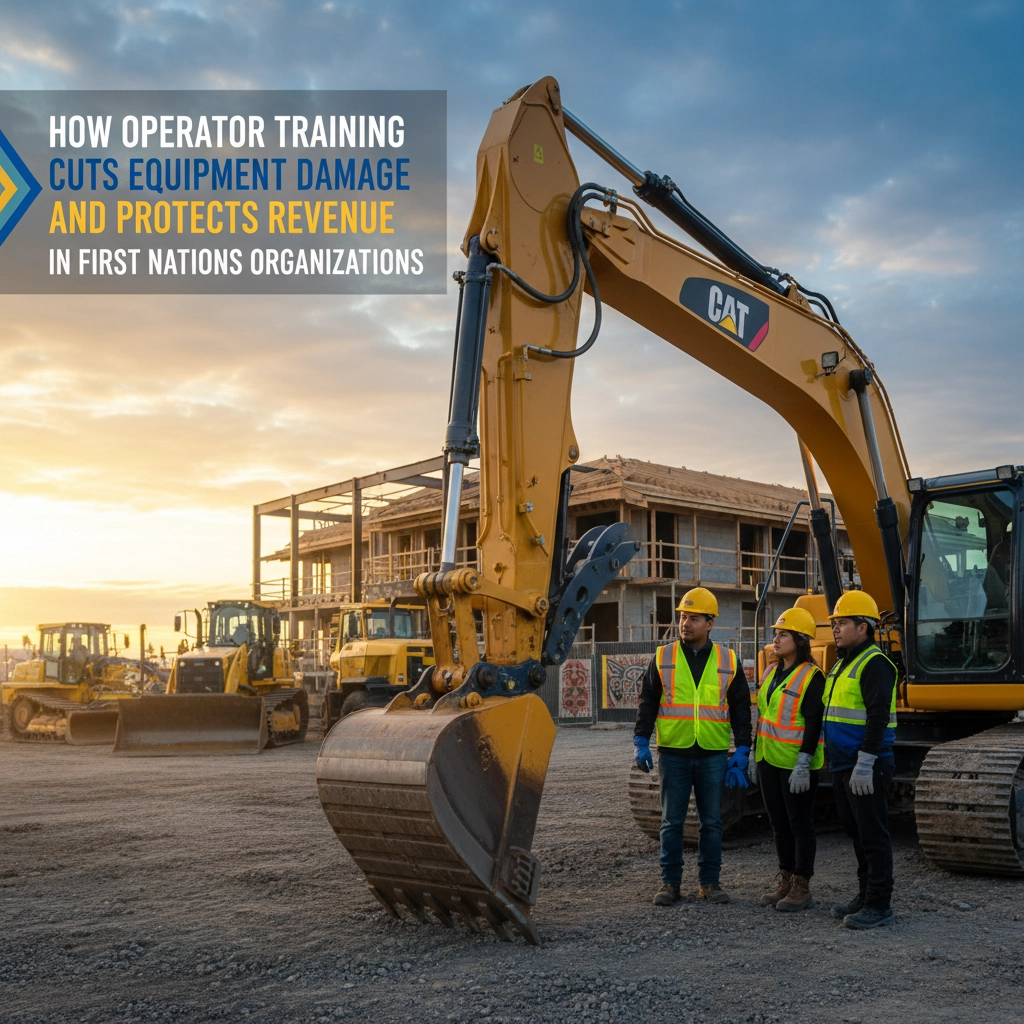
How Operator Training Cuts Equipment Damage and Protects Revenue in First Nations Organizations
How operator training helps First Nations organizations cut equipment damage, catch problems early, reduce downtime and protect revenue and services.
Last updated on October 1, 2026
What's new in this update
- Added current Manitoba regulatory context under The Workplace Safety and Health Act and Manitoba Regulation 217/2006, including Part 22 for powered mobile equipment
- Added the current lift truck operator training standard, CSA B335:25, and key expectations for retraining and practical evaluation
- Added the Manitoba regulatory timeline for M.R. 26/2026 and what larger project crews should prepare for now
- Added a current 2026 enforcement example showing the cost of missing instruction and procedures
- Added a fall and winter operating note for freeze-thaw cycles, ice, reduced daylight, and pre-shift ground checks
- Corrected references to Manitoba regulators and compensation bodies
When your skid steer breaks down in the middle of a critical project, you're not just looking at repair costs: you're facing lost revenue, delayed timelines, and frustrated community members. For First Nations organizations managing tight budgets and essential community services, equipment failures can derail operations and strain already limited resources.
The solution isn't buying more backup equipment or accepting breakdowns as inevitable. It's investing in proper operator training that transforms your team into your first line of defense against costly equipment damage.
The Real Cost of Equipment Damage in First Nations Operations
Equipment failures hit First Nations organizations particularly hard. Unlike private companies that can easily rent replacement equipment or absorb downtime costs, your operations directly impact community services and economic development initiatives.
Consider the ripple effects when a forklift operator damages hydraulics through improper use:
- Immediate repair costs: $3,000-$8,000 for hydraulic system repairs
- Downtime losses: 5-10 days of halted operations while waiting for parts
- Service disruption: Delayed community projects or essential services
- Replacement costs: Rental equipment at $200-400 per day
- Productivity loss: Work crew standing idle, wages still paid
These costs compound quickly. A single preventable breakdown can easily cost $15,000-$25,000 in direct and indirect expenses: money that could fund additional training programs or community development projects.
A recent Manitoba enforcement case shows how expensive missing instruction and procedures can become. On March 27, 2026, Manitoba Natural Resources and Indigenous Futures was convicted after a 2022 fatal ATV rollover. The case involved three contraventions under the Workplace Safety and Health Regulation and resulted in a $100,000 fine. It is a clear reminder that equipment failures tied to weak training, missing safe work procedures, or poor supervision are often the most expensive kind.
How Proper Training Prevents Costly Equipment Failures
Well-trained operators become your organization's best insurance policy against equipment damage. They understand how machines should perform under normal conditions, making them uniquely positioned to detect problems before they escalate into major failures.
Preventing Operator-Induced Damage
The majority of equipment failures stem from operator error or neglect. Untrained operators frequently cause damage through:
- Improper startup and shutdown procedures that shock hydraulic systems
- Running equipment beyond rated capacity limits
- Ignoring warning lights and alarm systems
- Failing to perform daily inspection and maintenance checks
- Using equipment for tasks it wasn't designed to handle

Each of these mistakes accelerates wear and can lead to catastrophic failures. Proper training eliminates these risk factors by teaching operators the correct procedures that equipment manufacturers designed to maximize machine life.
Understanding Equipment Limitations
Trained operators know their equipment's capabilities and limitations. They understand load charts for forklifts, ground pressure limits for skid steers, and operating angle restrictions for excavators. This knowledge prevents the overloading and misuse that causes expensive structural damage to frames, hydraulics, and drivetrain components.
Early Detection Saves Thousands in Repair Costs
Your operators spend more time with equipment than anyone else in your organization. When properly trained, they become early warning systems that can save thousands in repair costs through timely problem identification.
Recognizing Critical Warning Signs
Skilled operators learn to identify subtle indicators that untrained personnel miss:
- Unusual vibration patterns that signal bearing wear or alignment issues
- Hydraulic fluid temperature changes indicating system stress
- Engine performance variations that suggest developing problems
- Abnormal noise levels from drivetrain or hydraulic components
- Fluid leaks that start small but lead to major system failures
When operators catch these issues early, repairs typically cost hundreds rather than thousands. A small hydraulic leak identified and fixed immediately might cost $150 in seals and labor. The same leak ignored for weeks can destroy the entire hydraulic pump, costing $4,000-$6,000 to replace.
Revenue Protection Through Operational Reliability
For First Nations organizations, equipment downtime doesn't just cost money: it disrupts essential community services and economic development activities. Reliable equipment operation directly protects your organization's ability to generate revenue and serve community needs.
Maintaining Service Delivery Commitments
Whether you're operating a construction business, managing community infrastructure, or providing essential services, equipment reliability is crucial for meeting commitments. Trained operators reduce the likelihood of unexpected breakdowns that can:
- Force project delays and penalty costs
- Damage relationships with community members or clients
- Create safety hazards when equipment fails during critical operations
- Require expensive emergency repairs or equipment rental
Maximizing Equipment Utilization
Well-maintained equipment operated by trained personnel achieves higher utilization rates. Instead of frequent downtime for repairs, your machines stay productive, generating revenue or providing community services. This increased availability can easily justify training investments through improved operational capacity.

First Nations-Specific Training Considerations
First Nations organizations face unique challenges that make operator training even more critical for financial sustainability.
Funding and Accountability Requirements
Many funding programs require demonstrated capacity and training compliance before approving equipment investments. Provincial fire protection standards, for example, expect First Nations to meet training requirements before receiving capital equipment funding. This tiered approach recognizes that equipment investments only deliver value when operators have the skills to use them effectively.
Building Long-term Capacity
Operator training supports broader First Nations economic development goals by creating skilled workforce capacity within the community. Rather than relying on external contractors for equipment operation, trained community members can handle operations internally, keeping revenue and expertise within the community.
Geographic and Logistics Challenges
Remote locations make equipment failures more expensive and disruptive. When the nearest parts supplier or repair facility is hours away, preventing breakdowns through proper operation becomes even more valuable. Trained operators reduce the frequency of emergency service calls and parts orders that carry premium costs for remote delivery.
As fall turns into winter, these risks increase. Freeze-thaw cycles, ice, and reduced daylight change how equipment behaves and how quickly damage goes unnoticed. That makes pre-shift inspections, tire and track checks, and ground condition checks even more important heading into winter.
Building Long-term Equipment Investment Value
Equipment represents major capital investments for First Nations organizations. Proper operator training protects these investments by maximizing equipment lifespan and maintaining resale value.
Extending Equipment Life
Manufacturers design equipment for specific operating parameters. When operators follow these guidelines, machines can exceed their expected service life. A skid steer properly operated and maintained might last 8,000-10,000 hours instead of failing at 5,000-6,000 hours due to abuse or neglect.
Preserving Resale Value
Well-maintained equipment retains higher resale value when it's time to upgrade. Equipment with documented operator training and maintenance records commands premium prices in the used market. This preserved value provides more resources for your next equipment purchase.

Essential Training Components for Maximum ROI
To maximize the financial benefits of operator training, focus on these critical components:
Equipment-Specific Certification
Generic safety training isn't enough. Operators need certification on the specific equipment models your organization uses. Each machine has unique operating characteristics, safety systems, and maintenance requirements.
In Manitoba, this work sits under The Workplace Safety and Health Act and Manitoba Regulation 217/2006. Part 22 covers powered mobile equipment and sets the safety framework organizations need to follow when training and supervising operators.
For lift truck operations, the current training benchmark is CSA B335:25, released in May 2025, which replaced CSA B335-15. The updated standard recognizes online learning and virtual reality simulation for instruction and evaluation. At the same time, it still expects hands-on practical evaluation on the organization's own equipment. It also expects trainers to retrain every three years so their knowledge and evaluation skills stay current.
There is also an important Manitoba timeline to watch. M.R. 26/2026 was registered on March 20, 2026 and comes into force on April 1, 2027. It removes the construction site safety exemption for commercial, industrial, or institutional construction and renovation sites with more than 25 workers on site at any one time where the building is over 600 m2 or more than three storeys high. It also adds prime contractor duties under section 4.7. Organizations running their own crews on larger projects should prepare now by reviewing responsibilities, training records, and site safety systems before that change takes effect.
Preventive Maintenance Training
Teach operators to perform daily inspections, fluid level checks, and basic maintenance tasks. This prevents small issues from becoming major problems and reduces your dependence on expensive service technicians for routine maintenance.
Documentation and Reporting Systems
Train operators to document equipment hours, maintenance needs, and performance issues. This data helps you optimize maintenance schedules, identify recurring problems, and make informed decisions about equipment replacement timing.
Safety and Risk Management
Proper safety training prevents accidents that can result in equipment damage, worker injuries, and liability costs. The financial protection from accident prevention often exceeds the direct equipment protection benefits.
Measuring Training ROI
Track these metrics to demonstrate training value:
- Equipment downtime hours before and after training implementation
- Repair costs per operating hour compared to previous periods
- Accident rates and associated costs with trained versus untrained operators
- Equipment utilization rates and revenue generation capacity
- Maintenance cost trends over time with trained operators
Most organizations see positive ROI within 6-12 months of implementing comprehensive operator training programs.
For First Nations organizations balancing community service requirements with financial sustainability, operator training represents one of the most effective investments you can make. It protects equipment assets, maintains revenue-generating capacity, and builds valuable workforce capacity within your community.
When your operators understand their equipment and know how to use it properly, they become partners in protecting your organization's financial stability and operational success.
More guides
Need your operators certified?
We bring the training to your site, on your own equipment. Tell us the machines and how many operators and we reply the same business day.