Skid Steer Training, Skid Loader Training, and Skid Steer Certification: What Manitoba Employers Need to Know
Skid steer training and certification rules for Manitoba employers: Part 22 duties, common compliance failures, record-keeping and closing training gaps.
Last updated on October 1, 2026
What’s new in this update
- Corrected the M.R. 26/2026 timeline and clarified that the construction-site changes and prime contractor duties take effect on April 1, 2027.
- Updated the menstrual product requirement to reflect that it has been in force since September 1, 2026, including the workplace supply and disposal expectations.
- Replaced the older CSA reference with CSA B335:25 and added current training guidance on online delivery, virtual reality simulation, stronger risk assessment expectations, and trainer retraining every three years.
- Added 2026 Manitoba enforcement examples to show that missing operator instruction and documentation remain active compliance issues across sectors.
- Verified key external links, including the Global News source and Manitoba Workplace Safety and Health compliance page.
On a bitter December morning in the RM of Hanover, a skid steer went through thin ice. The operator didn’t make it home. Local coverage urged Manitobans to treat winter worksites with more respect for changing ice conditions and machine limits, a reminder that one assumption can have irreversible consequences. Source: Global News reporting on the Hanover fatality (Dec 2024): https://globalnews.ca/news/10934750/manitoba-ice-fatality-safety/
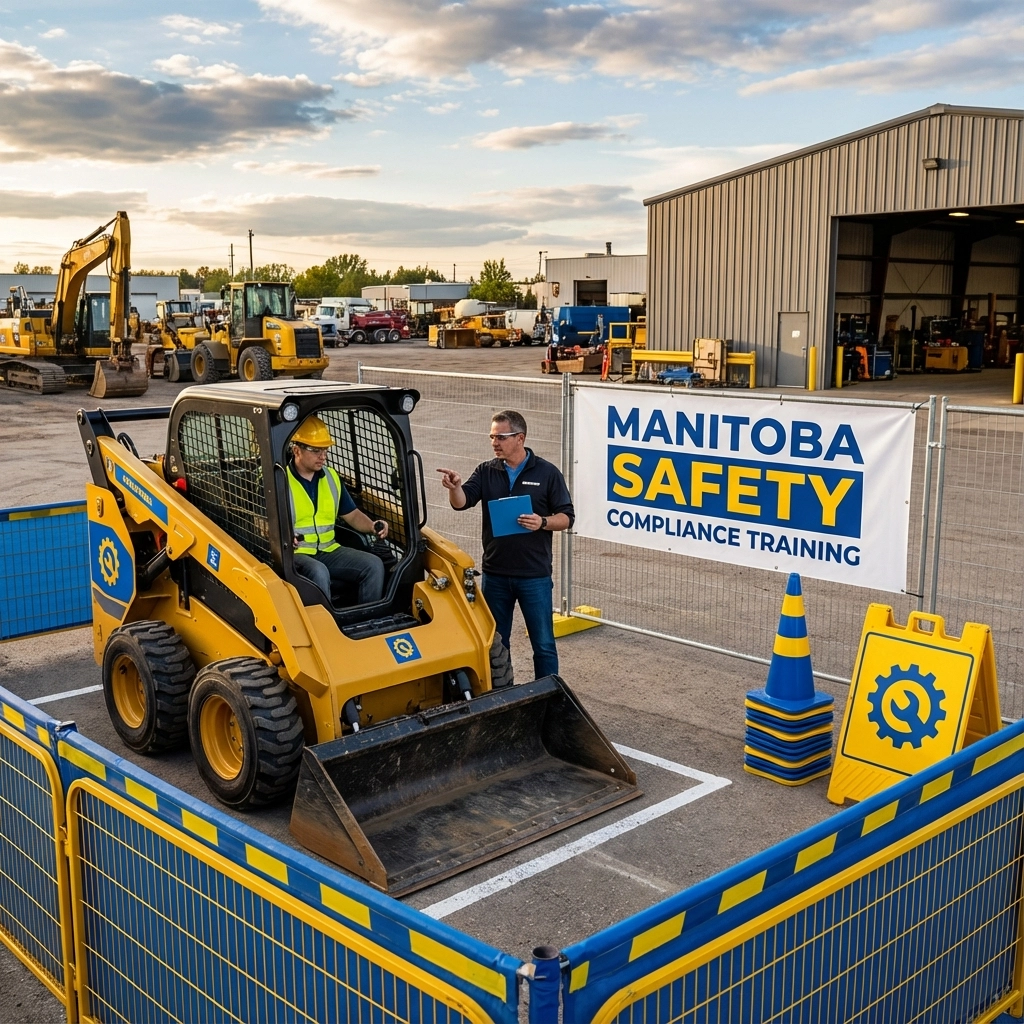
Whether you’re a safety officer or a site foreman, your job is to prevent the next incident—by putting competent operators on the controls, matching procedures to conditions, and keeping records that prove both. Compliance isn’t just about avoiding fines; it’s how you protect people, production, and equipment. For employers reviewing skid steer training, skid loader training, and skid steer certification requirements in Manitoba, this is also where heavy equipment operator training becomes a direct compliance issue, not just a scheduling task.
The Real Cost of Non-Compliance in Manitoba
Enforcement around powered mobile equipment has tightened in Manitoba. The province’s compliance summaries show that inadequate training and missing documentation lead to real costs—orders, fines, and downtime.
Enforcement remains active across every sector, not just construction. On January 27, 2026, Wintec Building Services Inc. was convicted and fined $50,000, plus $20,000 to the safety and health education fund. On March 27, 2026, Manitoba Natural Resources and Indigenous Futures was convicted after a 2022 fatal ATV rollover involving three Workplace Safety and Health Regulation contraventions and fined $100,000. Across these cases, the recurring theme is familiar: missing instruction, weak safe-work controls, and documentation that does not stand up under review.
Stop‑work orders are still being issued when competency records aren’t available on site—when work stops, revenue stops.
In one enforcement action, a construction company was fined $15,000 after an untrained operator caused a skid steer incident. Investigators found no formal training program and no operator certificates. This was preventable with competent training and documented evaluations.
Separate from enforcement files, a December 2024 fatality in the RM of Hanover—where a skid steer went through thin ice—reminded Manitobans that winter conditions amplify risk. As reported by Global News, operating on ice demands a hazard assessment, clear exclusion zones, and strict adherence to manufacturer limits. Source: https://globalnews.ca/news/10934750/manitoba-ice-fatality-safety/
What this means for your site:
- Verify operator competency against Part 22 and your site procedures before the keys are handed over.
- Keep certificates, practical evaluations, and refresher dates accessible during inspections.
- Pause operation if documentation or safe conditions are missing; resume only when gaps are closed.

Understanding Manitoba's Regulatory Framework for Skid Steer Training and Skid Loader Training
Part 22 Requirements for Powered Mobile Equipment
Manitoba Regulation 217/2006, Part 22, specifically governs the operation of powered mobile equipment, including skid steer loaders. Under these regulations, employers must ensure that operators are properly trained and competent before operating any powered mobile equipment.
Manitoba also registered M.R. 26/2026 on March 20, 2026, with changes coming into force on April 1, 2027. The regulation removes the safety exemption for commercial, industrial or institutional construction and renovation sites with more than 25 workers on site at any one time, or buildings over 600 m2 or more than three storeys, and adds prime contractor duties under section 4.7. For employers managing larger sites, that makes the April 1, 2027 deadline important for reviewing how training, supervision, and documentation will be applied in practice.
The regulation requires that operators demonstrate competency in:
- Equipment-specific operating procedures
- Pre-operational inspection protocols
- Hazard recognition and control measures
- Emergency procedures and equipment shutdown
- Safe loading and material handling practices
Employer Obligations Under the Workplace Safety and Health Act
Manitoba employers have specific legal obligations that extend far beyond simply hiring operators with experience. You must provide comprehensive training that covers both equipment operation and workplace-specific hazards. This includes ensuring operators understand site conditions, traffic patterns, and emergency procedures specific to your work environment.
As updated in 2026, employers on larger construction sites also need to prepare for broader site responsibility under the April 1, 2027 changes, including prime contractor duties on projects that meet the new threshold. This matters because safe equipment operation depends on more than machine handling alone. Workers must be able to report hazards, raise concerns, and stop unsafe work without hesitation.
Documentation requirements are equally critical. Employers must maintain records demonstrating that operators have received appropriate training and are competent to operate the equipment safely. During inspections, safety officers will request these records, and inability to provide proper documentation can result in immediate penalties.
Employers must also comply with Manitoba’s menstrual product requirement, now in force since September 1, 2026. Provincially regulated workplaces must provide free tampons and pads, along with a covered disposal container near each toilet. Non-compliance can lead to fines of up to $5,000. While this is separate from operator competency, it reflects the province’s wider expectation that employers manage site conditions in a complete and practical way.
Common Compliance Failures and Their Consequences
Inadequate Training Documentation
Many employers assume that an operator's previous experience or basic certification is sufficient. However, Manitoba regulations require site-specific training and ongoing competency assessments. Companies have faced penalties for failing to document refresher training or for accepting outdated certifications from other provinces without Manitoba-specific updates.
Insufficient Pre-Operational Procedures
Skid steer loaders require daily pre-operational inspections, and operators must be trained to identify potential hazards and equipment defects. Keep this front and centre during fall and winter roadwork and site prep, when icy ground, reduced daylight, changing surfaces, and attachment use can increase risk. Recent enforcement actions have targeted companies where operators couldn't demonstrate proper inspection procedures or where inspection records were incomplete or falsified.
Attachment-Specific Training Gaps
Skid steers often use various attachments that change the equipment's handling characteristics and safety requirements. Employers frequently overlook the need for attachment-specific training, leading to incidents and subsequent investigations. Each attachment requires its own training component and competency demonstration.

The Training Solution: Meeting Manitoba Standards for Skid Steer Training and Skid Steer Certification
Comprehensive Operator Certification Programs
Effective skid steer training programs must address both regulatory requirements and practical workplace applications. Quality training includes classroom instruction covering theoretical knowledge, followed by hands-on practical training with competency testing.
Modern training approaches combine traditional classroom learning with practical field exercises that simulate real workplace conditions. This ensures operators can apply their knowledge in actual work environments rather than just passing theoretical tests.
Key Training Components for Compliance
Successful training programs address all mandatory elements while incorporating site-specific hazards and procedures. Essential components include:
- Equipment familiarization and controls operation
- Pre-operational inspection procedures and documentation
- Load handling and stability principles
- Site-specific hazard recognition
- Emergency procedures and incident response
- Maintenance reporting and equipment care
Training must also cover regulatory requirements specific to Manitoba, including documentation standards and ongoing competency requirements. Operators need to understand their responsibilities under provincial safety legislation, not just how to operate the equipment.
For employers aligning training with current Canadian practice, CSA B335:25 is now the recognized baseline for lift truck operator training in Canada, replacing CSA B335-15 in May 2025. The updated standard recognizes online learning and virtual reality simulation as delivery and evaluation methods, places stronger emphasis on risk assessment, and expects trainers to complete retraining every three years. While skid steer training is governed by Manitoba’s powered mobile equipment rules, this current CSA direction reinforces the same compliance principle: training must be current, practical, documented, and defensible.
Documentation and Record-Keeping Requirements
Creating Audit-Ready Training Records
Manitoba safety inspectors expect to see comprehensive training documentation that demonstrates ongoing compliance efforts. Effective record-keeping systems include training certificates, competency assessments, refresher training schedules, and incident reports.
Your documentation should clearly show when training was completed, who provided the instruction, what content was covered, and how competency was assessed. Digital record-keeping systems can help ensure information is easily accessible during inspections and properly backed up for long-term retention.
Ongoing Competency Monitoring
Compliance extends beyond initial certification. Employers must implement systems to monitor ongoing operator competency through regular assessments, incident analysis, and refresher training programs. This proactive approach demonstrates commitment to safety and helps identify potential issues before they result in incidents or violations.

Practical Solutions for Manitoba Employers Using Heavy Equipment Operator Training
Implementing a Compliant Training Program
Start by conducting a comprehensive assessment of your current training practices against Manitoba regulatory requirements. Identify gaps in documentation, training content, or competency assessment procedures. This assessment provides the foundation for developing a compliant training program.
Work with qualified training providers who understand Manitoba-specific requirements and can deliver training that meets both regulatory standards and your operational needs. Look for providers who offer comprehensive operator training programs that support both skid steer training Manitoba needs and broader heavy equipment operator training across your operation.
Developing Internal Training Capacity
Consider developing internal training capabilities through train-the-trainer programs. This approach provides greater flexibility for scheduling refresher training and addressing site-specific requirements while ensuring consistent training quality across your organization.
Internal trainers must receive proper certification and ongoing professional development to maintain their qualifications. This investment pays dividends through reduced training costs and improved training accessibility for your workforce.
Creating Sustainable Compliance Systems
Effective compliance requires systems that integrate training with daily operations. Develop procedures that make compliance activities routine rather than burdensome additions to normal work processes.
Implement digital systems for tracking certifications, scheduling refresher training, and maintaining inspection records. These systems should provide automatic alerts for upcoming certification renewals and generate reports for safety meetings and regulatory inspections.
Taking Action: Your Compliance Roadmap
Immediate Steps for Employers
Begin by auditing your current skid steer operator training and documentation. Review all operator certifications to ensure they meet current Manitoba standards and haven't expired. Document any training gaps and create a prioritized action plan for addressing deficiencies.
Schedule refresher training for operators whose certifications are approaching expiration or who haven't received recent competency assessments. This proactive approach prevents compliance gaps and demonstrates good faith efforts to maintain safety standards.
Long-Term Compliance Strategy
Develop a comprehensive equipment operator training policy that addresses all powered mobile equipment in your operations. This policy should outline training requirements, documentation standards, and ongoing competency assessment procedures.
Partner with qualified training providers who can support your long-term compliance needs. Look for providers offering flexible scheduling, on-site training options, and ongoing support services that adapt to your changing operational requirements.
Ensure Your Compliance with Professional Training
Don't let inadequate training put your workers at risk and your business in jeopardy. Manitoba's enforcement actions demonstrate that proper operator training is essential for both safety and regulatory compliance.
Onsite Training Services provides comprehensive skid steer operator training designed specifically to meet Manitoba regulatory requirements. Our experienced instructors deliver practical, hands-on training that ensures your operators are fully competent and your documentation meets inspection standards.
Contact us today to schedule training for your operators and develop a compliance program that protects your workforce and your business. With flexible scheduling and on-site delivery options, we make compliance convenient and cost-effective for Manitoba employers.
Contact Onsite Equipment Training to book your certification program.
More guides
Need your operators certified?
We bring the training to your site, on your own equipment. Tell us the machines and how many operators and we reply the same business day.