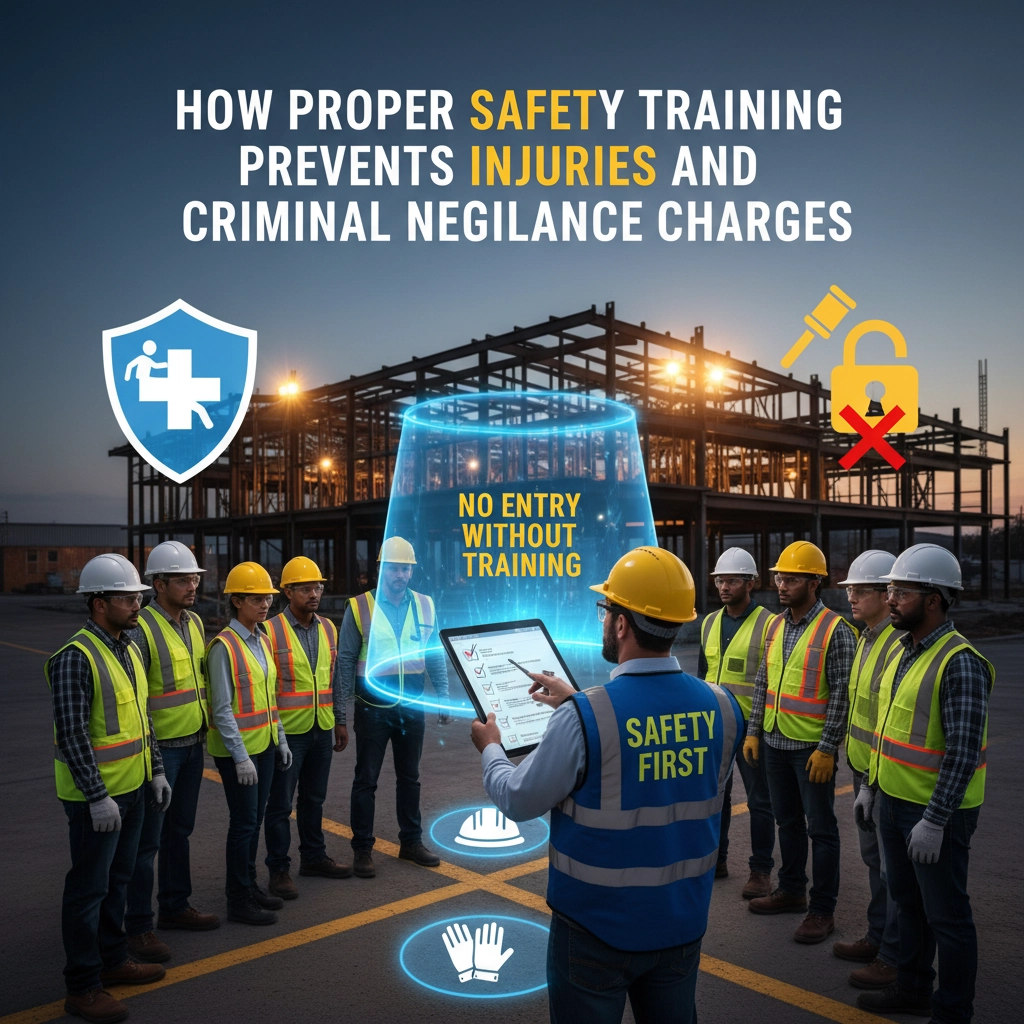
How Proper Safety Training Prevents Injuries and Criminal Negligence Charges
How proper equipment safety training and records help Manitoba employers prevent injuries, show due diligence and avoid criminal negligence charges.
Last updated on October 1, 2026
What's new in this update:
- Replaced OSHA-based claims with Canadian and Manitoba legal and safety context
- Updated the legislation section to reflect The Workplace Safety and Health Act, Manitoba Regulation 217/2006, Part 22, and current CSA requirements
- Added Manitoba's 2026 regulatory timeline, including M.R. 26/2026 and its April 1, 2027 in-force date
- Added verified Manitoba conviction examples from 2025 and 2026
- Clarified the difference between Criminal Code duties and provincial workplace safety duties
- Removed the Manitoba-specific framing around a U.S. return-on-investment figure
When someone gets hurt on the job due to improper equipment operation, the consequences extend far beyond the immediate injury. Employers face potential criminal charges, devastating lawsuits, and regulatory penalties that can shut down operations permanently. For First Nations communities investing in workforce development, understanding these legal realities isn't just important: it's essential for protecting both workers and the organizations that hire them.
The statistics are sobering: workplace injuries cost Canadian employers billions annually, while criminal negligence charges under the Criminal Code can result in unlimited fines and imprisonment for company officers. However, proper safety training creates a powerful legal shield while helping reduce incidents, downtime, and equipment damage. Here's what every employment counselor, band administrator, and job seeker needs to know about the critical connection between training and legal protection.
The Legal Landscape: When Accidents Become Criminal Matters
Under Canadian criminal law, employers have a legal duty to protect worker safety. In Manitoba, that duty also sits under The Workplace Safety and Health Act and Manitoba Regulation 217/2006, including Part 22, which covers powered mobile equipment. For lift truck operations, applicable CSA standards also matter. The current lift truck operator standard is CSA B335:25, released in May 2025, which replaced CSA B335-15. It recognizes online learning and virtual reality simulation for instruction and evaluation, expects trainers to retrain every three years, and still requires hands-on evaluation before operators are considered competent.
When these duties are ignored through inadequate training, what might appear to be an "accident" can quickly escalate into enforcement, prosecution, or criminal charges. The Criminal Code specifically addresses criminal negligence, which occurs when someone shows "wanton or reckless disregard for the lives or safety of other persons."
In workplace contexts, this often translates to failing to provide proper equipment training. If an untrained forklift operator causes a fatality, or an improperly trained heavy equipment operator injures a coworker, investigators will scrutinize the employer's training records. Did the company provide comprehensive training? Was it documented? Did they ensure competency before allowing independent operation?
The consequences are severe. Criminal negligence causing death can result in life imprisonment, while criminal negligence causing bodily harm carries penalties up to 10 years in prison. These aren't just theoretical risks. Manitoba employers can also face separate provincial enforcement under workplace safety law, even when no criminal charge is laid.

The Injury Prevention Statistics That Matter
Research and field experience continue to show the same basic truth: structured safety training helps reduce workplace incidents. In Manitoba, this matters because powered mobile equipment hazards are managed through safe work procedures, operator instruction, supervision, and documented competency. That is the practical standard employers are expected to meet.
For heavy equipment and material handling operations, training supports safer habits in several ways:
Knowledge and Behavior Improvements:
- Workers understand equipment limits and site hazards
- Operators learn proper inspections before use
- Supervisors can verify who is trained for specific equipment
- Sites have stronger documentation when refresher training is due
- Teams are more likely to follow safe work procedures consistently
These are not just administrative improvements. They help prevent injuries, protect families, and support stronger workforce outcomes for communities.
Documentation: Your Legal Shield
Proper training documentation serves as crucial evidence of due diligence when accidents occur. Courts and regulatory bodies examine training records to determine whether employers met their legal obligations. Inadequate documentation can turn a workplace accident into a criminal case, while comprehensive records demonstrate responsible safety management.
Essential documentation includes:
- Individual training certificates showing specific competencies achieved
- Skills evaluation records documenting hands-on assessments
- Trainer qualifications and current certification status
- Equipment-specific training completion records
- Refresher and retraining documentation
- Pre-operation inspection training records
- Competency assessments that show the worker was evaluated before independent operation
At Onsite Training Services, every student receives detailed certification that meets legal requirements. Our wallet card system provides immediate proof of training completion, while comprehensive training records create the paper trail that protects both workers and employers.

Real-World Consequences of Inadequate Training
The failure to provide proper equipment training creates multiple liability exposures. Common scenarios that lead to legal action include:
Equipment Operation Failures:
- Operators who haven't learned proper load calculations causing tip-overs
- Forklift operators without adequate training striking pedestrians or structures
- Heavy equipment operators causing property damage or injuries due to inadequate skills
- Workers injured because they weren't trained on equipment-specific safety procedures
Regulatory Violations:
- Provincial safety regulators can issue stop-work orders for untrained operators
- Fines and penalties for non-compliance with training requirements
- Increased insurance premiums following training-related incidents
- Loss of operating permits or licenses
Criminal Liability:
- Charges under the Criminal Code for criminal negligence
- Corporate liability for failing to establish adequate safety systems
- Personal liability for supervisors and managers who authorized untrained operation
- Potential imprisonment for company officers in severe cases
Recent Manitoba cases show that these consequences are real:
- On March 27, 2026, Manitoba Natural Resources and Indigenous Futures was convicted after a 2022 fatal ATV rollover. The case involved three contraventions under the Workplace Safety and Health Regulation, and the employer was fined $100,000.
- On January 27, 2026, Wintec Building Services Inc. was convicted after a worker died after contact with unguarded machinery. The court imposed a $50,000 fine plus $20,000 to the safety education fund.
- In November 2025, Ital-Stone Design Ltd. was convicted in a forklift-related incident involving material handling. The penalty was $20,000 plus $5,000 to the education fund.
These cases also show an important legal point: provincial duties under The Workplace Safety and Health Act and criminal duties under the Criminal Code are separate tracks. An employer may face provincial prosecution, criminal investigation, or both, depending on the facts. In either track, documented training, testing, and competency assessment are central to proving due diligence.
The legal system doesn't accept "we didn't know" as a defense. Employers are expected to understand and meet their training obligations, regardless of company size or experience level.
How Comprehensive Training Programs Address Legal Requirements
Professional training programs like those offered through our operator training courses address both safety and legal requirements through systematic approaches that courts and regulators recognize as meeting due diligence standards.
Regulatory Compliance:
Our programs align with provincial safety regulations and industry standards. In Manitoba, that means training should reflect The Workplace Safety and Health Act, Manitoba Regulation 217/2006, including Part 22 for powered mobile equipment, and applicable CSA standards. For example, our forklift certification program is designed to support Manitoba compliance while providing the structured training that helps prevent injuries and legal exposure.
In the Manitoba regulatory timeline, there is also an important update ahead. M.R. 26/2026 was registered on March 20, 2026 and comes into force on April 1, 2027. It removes the construction site safety exemption for commercial, industrial, or institutional construction and renovation sites with more than 25 workers on site at any one time where the building is over 600 m2 or more than three storeys. It also adds prime contractor duties under section 4.7. For communities involved in construction-related workforce development, this means site safety expectations will become more formal on larger projects.
Competency-Based Assessment:
Rather than simply providing classroom instruction, effective training includes hands-on evaluation that demonstrates actual competency. Students must prove they can safely operate equipment before receiving certification. That expectation continues under current CSA guidance, even where online learning or virtual simulation is used for part of the instruction.
Ongoing Safety Culture:
Professional training instills safety awareness that extends beyond basic equipment operation. Workers learn to recognize hazards, follow proper procedures, and understand their role in maintaining safe work environments.

The Financial Impact: Beyond Legal Protection
While legal protection is a major reason to invest in training, the financial benefits also matter. Proper training can help reduce claims, downtime, equipment damage, investigation costs, and disruption after an incident. A commonly cited $4.41 to 1 return figure comes from U.S. research, so it should not be treated as a Manitoba-specific number. The broader point still holds: safer, better-documented operations usually cost less over time than preventable incidents.
For First Nations communities developing their workforce, this creates a competitive advantage. Employers increasingly seek workers with verified training credentials because they understand the legal and financial risks of hiring untrained operators. Graduates from comprehensive programs like Workforce Ready command higher starting wages because they bring immediate value and reduced liability risk.
Return on Investment Factors:
- Reduced insurance premiums for employers hiring trained workers
- Lower workers' compensation experience ratings
- Decreased legal costs and regulatory penalties
- Improved productivity through proper equipment operation
- Reduced equipment damage from operator errors
- Enhanced reputation and competitive positioning
Creating Defensible Training Systems
For training to provide maximum legal protection, it must meet specific criteria that courts and regulators recognize as adequate:
Comprehensive Content: Training must cover all aspects of safe operation, including equipment-specific hazards, proper operating procedures, maintenance requirements, and emergency protocols.
Qualified Instructors: Trainers must possess both technical expertise and proper instructional credentials. Our training team brings a combined 12+ years of industry experience, and our instructors hold recognized teaching and trainer qualifications.
Hands-On Assessment: Classroom knowledge alone isn't sufficient. Students must demonstrate practical competency through supervised equipment operation and skills testing.
Current Standards: Training content must reflect current regulations, manufacturer specifications, applicable CSA standards, and industry best practices. Outdated training creates legal vulnerabilities.
Individual Certification: Each worker must receive individual certification that specifically documents their training completion and competency verification.
Protecting First Nations Communities Through Proper Training
For First Nations employment and training departments, understanding these legal realities helps create programs that truly serve community members. Workers who complete comprehensive training programs don't just gain employment skills: they enter the workforce with credentials that protect them and their future employers from preventable legal consequences.
This protection becomes particularly important when community members work for band-owned enterprises or local contractors. Proper training documentation helps these employers meet their legal obligations while creating opportunities for community economic development through skilled, certified workers.
The path forward is clear: invest in comprehensive training that meets legal requirements while building genuine competency. The alternative: inadequate training that exposes workers and employers to criminal liability: simply isn't acceptable when proper programs are readily available.
When you're ready to explore training options that provide both safety and legal protection, contact us to discuss how our programs can serve your community's workforce development goals while meeting the highest safety and legal standards.
More guides
Need your operators certified?
We bring the training to your site, on your own equipment. Tell us the machines and how many operators and we reply the same business day.