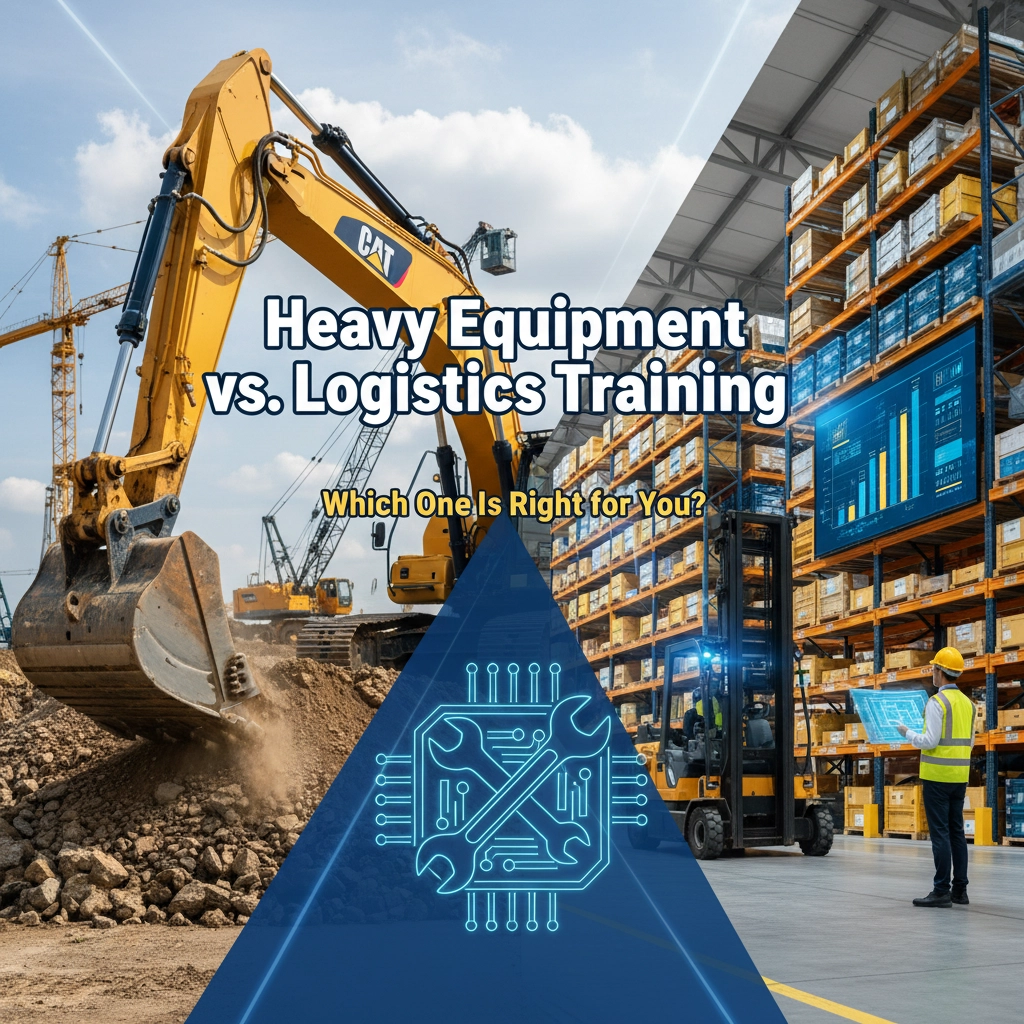
Heavy Equipment vs. Logistics Training: Which One Is Right for You?
Heavy equipment or logistics training? Compare the 2-week heavy equipment and 1-week forklift programs: wages, work environment and Manitoba job demand.
Last updated on October 1, 2026
What's new in this update:
- Corrected the funding section to reflect current training supports that actually apply
- Added the 2026-2027 Manitoba regulatory timeline that will increase demand for certified operators
- Updated the logistics section with the current CSA B335:25 lift truck training standard
- Added September 2026 mining and critical minerals context affecting employer demand
- Clarified wage ranges as typical Manitoba ranges rather than guarantees
Choosing the right training program can feel overwhelming, especially when you're looking at two solid career paths that both promise good employment outcomes. If you're working with First Nations job seekers in Manitoba or considering training options yourself, you've probably wondered: should I focus on heavy equipment operation or logistics training?
Both paths offer real opportunities for stable employment and decent wages. Both can get you job-ready in a matter of weeks, not years. But they lead to very different day-to-day work experiences and career trajectories.
Let's break down exactly what each training path offers, so you can make the best decision for your situation and goals.
What Is Heavy Equipment Training?
Heavy equipment training prepares you to safely operate the machinery that builds our communities – skid steers, excavators, telehandlers, and more. In our Workforce Ready program, this typically means a comprehensive 2-week course that covers multiple pieces of equipment.
What you'll learn:
- Safe operation of skid steers, telehandlers, and excavators
- Pre-operation inspections and basic maintenance
- Load calculations and stability principles
- Jobsite safety protocols and communication
- Proper documentation and logbook requirements
The training is hands-on from day one. You're not just reading about how to operate a skid steer – you're actually running one, learning to feel how it responds, understanding its capabilities and limitations.
Who hires heavy equipment operators:
- Construction companies (residential and commercial)
- Municipal public works departments
- First Nations infrastructure projects
- Landscaping and excavation contractors
- Mining and resource extraction companies
- Utility companies

What Is Logistics Training?
Logistics training focuses on the movement and handling of goods – typically through forklift operation and warehouse management. This is usually a more focused 1-week program that gets you certified to operate powered industrial trucks in warehouse and distribution environments.
What you'll learn:
- Forklift operation (counterbalance, reach truck, order picker)
- Load handling and stacking techniques
- Warehouse safety protocols
- Inventory management basics
- WHMIS and hazardous materials handling
The emphasis here is on precision, efficiency, and safety in controlled environments like warehouses, distribution centers, and manufacturing facilities.
As of May 2025, CSA B335:25 replaced CSA B335-15 as the recognized baseline for lift truck operator training in Canada. The updated standard recognizes online learning and virtual reality simulation as tools for instruction and evaluation, while still expecting trainers to retrain every three years. Hands-on practical evaluation is still required for certification, which means learners still need to show they can operate the equipment safely in real working conditions.
Who hires logistics-trained workers:
- Warehousing and distribution companies
- Manufacturing facilities
- Retail distribution centers
- Food processing and cold storage facilities
- Third-party logistics (3PL) providers
- Port and transportation hubs
The Real Differences: Duration, Salary, and Work Environment
Training Duration
Heavy Equipment: 2 weeks
- More comprehensive equipment coverage
- Multiple machine certifications
- Extensive hands-on practice time
- Construction jobsite simulation
Logistics: 1 week
- Focused forklift certification
- Warehouse environment training
- Quick entry into employment
- Streamlined, efficient curriculum
Salary Expectations
Heavy equipment operators in Manitoba typically earn about $18-$22 per hour when starting out, with experienced operators often earning $25-$30+ per hour. These are typical Manitoba ranges, not guarantees. The work is often project-based, which can mean periods of high earnings followed by slower periods.
Forklift operators in Manitoba typically earn about $16-$20 per hour when starting out, with warehouse leads and experienced operators often reaching $22-$26 per hour. These are also typical Manitoba ranges, not guarantees. The work tends to be more consistent year-round, with steady schedules.
Work Environment Differences
Heavy Equipment Work:
- Outdoor jobsites (weather-dependent)
- Varied locations and projects
- Team-based construction environment
- Physical demands vary by equipment
- Seasonal fluctuations in some regions
Logistics Work:
- Indoor warehouse environments
- Consistent location and routine
- Individual task focus with team coordination
- Moderate physical demands
- Year-round steady employment

Which Training Path Matches Your Goals?
Choose Heavy Equipment Training If You:
Want variety and adventure
Every project is different. One week you might be helping build a new community center, the next you're working on road improvements or utility installations.
Enjoy problem-solving
Construction work requires constant adaptation. Ground conditions change, weather affects operations, and each jobsite has unique challenges.
Can handle weather and seasonal work
Construction activity naturally fluctuates with seasons in Manitoba. You'll have busy periods and slower times, which some people prefer.
Like working as part of a crew
Construction is collaborative. You'll work closely with other trades, supervisors, and project managers.
Choose Logistics Training If You:
Value consistency and routine
Warehouse work offers predictable schedules, consistent work environments, and steady year-round employment.
Prefer indoor work
Climate-controlled warehouses mean you're not dealing with Manitoba winters or summer heat while working.
Want faster entry into employment
One week of training gets you job-ready quickly, which is ideal if you need to start earning immediately.
Like individual responsibility
While you're part of a team, much of forklift work involves individual tasks where you can work at your own pace.
Employer Demand in Manitoba
Both skillsets are in demand, but in different sectors:
Heavy Equipment demand is strong in:
- Winnipeg's ongoing infrastructure projects
- Northern Manitoba mining and resource development
- First Nations community infrastructure improvements
- Municipal road and utility work
That demand is likely to grow even more because Manitoba's construction safety rules are tightening. M.R. 26/2026 was registered on March 20, 2026 and comes into force on April 1, 2027. It removes the construction site safety exemption for commercial, industrial, or institutional construction and renovation sites with more than 25 workers on site at any one time where the building is over 600 m2 or more than three storeys, and it adds prime contractor duties under section 4.7. As that change takes effect, certified operators will be in even more demand on larger worksites.
Logistics demand is growing in:
- Winnipeg's position as a transportation hub
- E-commerce fulfillment centers
- Food distribution and cold storage
- Manufacturing facilities throughout the province
There is also added pressure on the heavy equipment side from Manitoba's mining and critical minerals push. September 2026 Winnipeg Free Press reporting noted that the province is trying to grow mineral production while First Nations training capacity is still lagging in some areas. That gap favours practical heavy equipment skills right now because employers need workers who can step into field, construction, and resource-support roles sooner.

Funding Considerations for First Nations Students
Both training programs may qualify for funding streams available to First Nations students, depending on the learner, the community, and the training plan. Common options include:
- The Indigenous Skills and Employment Training (ISET) program delivered through Indigenous service delivery organizations and tribal councils
- Band-level employment assistance programs
- Provincial training supports where eligible
A current example is the new 15-month Drinking Water Internship delivered with First Peoples Development Inc. and supported through ISET as of September 2026. It shows how funded operator training can lead to recognized certification in a field that communities need.
The shorter duration of logistics training means lower total funding requirements, which can be easier to approve quickly. However, the higher earning potential of heavy equipment operation often justifies the additional investment.
Pro tip: Some students complete forklift training first to start earning immediately, then pursue heavy equipment training later when they have more financial stability.
Making Your Decision: A Practical Framework
Ask yourself these key questions:
-
How quickly do you need to start working? If it's urgent, logistics training gets you employed faster.
-
What work environment energizes you? Outdoor variety vs. indoor consistency – both have benefits.
-
How important is earning potential vs. job security? Heavy equipment offers higher peaks, logistics offers more stability.
-
What's the job market like in your specific area? Research local demand for both skillsets.
-
Do you have reliable transportation? Construction sites may be more scattered than warehouse locations.
Your Next Steps
The best choice depends on your individual situation, career goals, and personal preferences. Both paths offer legitimate opportunities for stable employment and career growth.
If you're still unsure, consider talking with recent graduates from both programs. Many employment counsellors can connect you with alumni who can share their real-world experiences.
Remember: this doesn't have to be a permanent decision. Many workers start in one field and transition to another as their skills and interests develop. The important thing is taking that first step toward skills training that will open doors to better employment opportunities.
Whether you choose the variety and earning potential of heavy equipment or the stability and consistency of logistics work, you're investing in skills that Manitoba employers need and value.
Ready to explore your options? Contact us to discuss which program might be the best fit for your goals and situation.
Contact Workforce Ready to plan equipment operator training for your community.
More guides
Need your operators certified?
We bring the training to your site, on your own equipment. Tell us the machines and how many operators and we reply the same business day.